2026-10-07 産業技術総合研究所
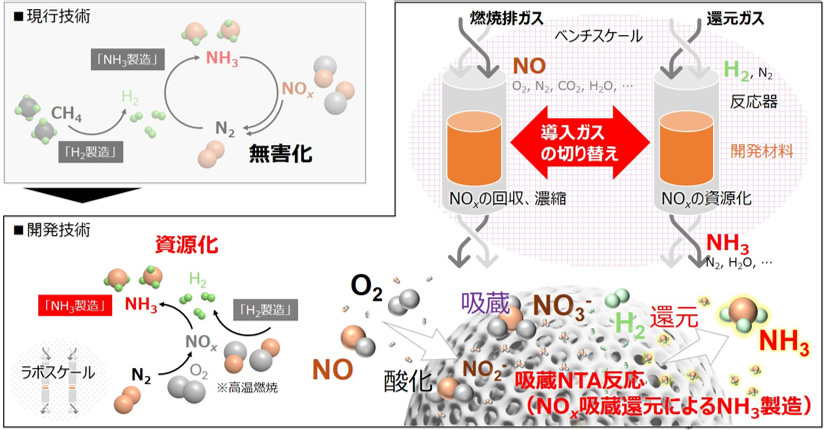
※原論文の図を引用・改変したものを使用しています。
<関連情報>
- https://www.aist.go.jp/aist_j/press_release/pr2026/pr20261007/pr20261007.html
- https://pubs.rsc.org/cy/article/15/21/6477/888662/Size-dependent-properties-of-Pt-catalysts-for-the
- https://onlinelibrary.wiley.com/doi/10.1002/tcr.202400094
- https://pubs.rsc.org/cy/article-abstract/13/10/2927/804209/Catalytic-conversion-to-ammonia-through-solid
BaO/Pt/γ- Al₂O₃を用いたガス切り替え型NOx貯蔵還元プロセスにおけるNH₃合成の ためのPt触媒のサイズ依存性特性 Size-dependent properties of Pt catalysts for the synthesis of NH3 during a gas-switching NOx storage and reduction process using BaO/Pt/γ-Al2O3
Atsuko Tomita;Ryutaro Wakabayashi;Tatsuo Kimura
Catalysis Science & Technology Published:16 September 2025
DOI:https://doi.org/10.1039/d5cy00778j
Nitrogen oxides (NOx), though harmful, serve as an effective nitrogen source owing to their higher reactivity compared to atmospheric nitrogen (N2). For example, an alternate gas-switching process has been proposed in which NOx is stored and then reduced by hydrogen (H2) at a constant temperature below 300 °C, enabling the selective synthesis of valuable ammonia (NH3). In this study, we demonstrated the size-dependent properties of a platinum (Pt) catalyst for further understanding the activation of H2 and subsequent hydrogenation of stored NOx in the reduction process using systematically designed BaO/Pt/γ-Al2O3 type nanocomposite catalysts. The hydrogenation rate over γ-Al2O3 was governed almost completely by the size of the resulting Pt nanoparticles (NPs), which could be tuned solely by adjusting the reaction temperature; the catalytic properties in activation of H2 followed the same trend. The formation of N2 progressed preferentially with the rapid hydrogenation of stored NOx by highly active (smaller) Pt NPs, which is not contradictory to the fact that sufficient but slow hydrogenation of stored NOx was helpful for the synthesis of NH3 by activity-controlled (larger) Pt NPs. Consequently, in the presence of sufficient H2, more than 90% of stored NOx can be recovered as NH3 above 200 °C by using BaO/Pt/γ-Al2O3 containing large Pt NPs. This knowledge has potential for the design of high-performance nanocomposite catalysts to produce starting NH3 for value-added chemicals and CO2-free fuels as strategic chemicals in the future society.
窒素循環経済における反応性窒素化合物の利用 Utilization of Reactive Nitrogen Compounds for Nitrogen Circular Economy
Dr. Tatsuo Kimura
The Chemical Record Published: 02 August 2024
DOI:https://doi.org/10.1002/tcr.202400094
Abstract
Nitrogen oxides (NOx) should be purified according to environmental regulations, being restricted increasingly year by year. A wide variety of denitration technologies, such as selective catalytic reduction (SCR) of NOx to nitrogen (N2) and NOx storage reduction (NSR) to N2 by injecting reducing agents like ammonia (NH3), has so far been developed practically. Sophisticated catalytic approaches are perhaps mandatory for the sustainability in energy including complete purification of NOx. As one of the solutions to overcome problems for environment and resource simultaneously, this concept article focuses on the utilization of reactive nitrogen (Nr) compounds, mainly NOx, for encouraging an opening to consider nitrogen circular economy. For the recycling of NOx via NH3, a challenging but rational catalytic technology can be proposed by an alternate switching the inlet gas between NOx containing oxidative gas and H2 containing reductive one without an operation to change the reaction temperature. Considering the reactivity of NOx higher than that of N2, this kind of NOx to NH3 (NTA) process is promising for synthesizing NH3, being valuable not only as fertilizer but also as fuel in near future.
固体硝酸塩を介したアンモニアへの触媒変換:窒素酸化物の新たな利用法の提案 Catalytic conversion to ammonia through solid-state nitrate as a proposal for the emerging usage of nitrogen oxides
Atsuko Tomita;Ryutaro Wakabayashi;Tatsuo Kimura
Catalysis Science & Technology Published:27 February 2023
DOI:https://doi.org/10.1039/d3cy00169e
Nitrogen oxides, NOx, that arise anthropogenically from combustion at high temperature using air are serious byproducts that cause air pollution. Here, we propose a catalytic conversion system by alternate switching of inlet gas from NOx containing O2-rich combustion gas (e.g., 1000 ppm NO + 10% O2) to NO/O2-free reduction one (e.g., 1% H2). According to this gas-switching operation, solid-state nitrate, stored with alkali earth metal species, was converted to gaseous NH3 under ambient pressure, which would possibly be useful for solving the nitrogen crisis as well as constructing a new industrial structure of a circular nitrogen economy. Large Pt nanoparticles inside mesoporous alumina particles, created by an aerosol-assisted one-pot synthesis with Pt sources followed by calcination at high temperature (e.g., 850 °C), were helpful for shifting the efficient-working temperature to a higher region. A Ba/Pt@mAl2O3(γ) type nanocomposite catalyst worked very well at 250 °C and higher. Selectivity for NH3 reached 90%, and was also achieved using Ca/Pt@mAl2O3(γ), without a high-energy process like the cleavage of N2.