2026-10-06 スタンフォード大学
<関連情報>
- https://news.stanford.edu/stories/2026/10/pollution-levels-commercial-kitchens-gas-stoves
- https://iopscience.iop.org/article/10.1088/1748-9326/ae9d96
業務用厨房における燃焼由来の大気汚染物質やガス器具からの熱は、健康に関するガイドラインを超える可能性がある Combustion-derived air pollution and heat from gas-fired appliances in commercial kitchens can exceed health-based guidelines
Yannai S Kashtan, Eric D Lebel, Nicole Lucha, Colin Finnegan, Gan Huang, Tamara L Sparks, Abenezer Shankute, Antonio F Saporito, Christopher A Galarza, Robert B Jackson,…
Environment Research Letters Published: 6 October 2026
DOI:10.1088/1748-9326/ae9d96
Abstract
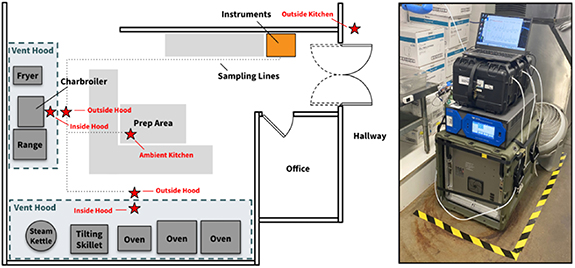
Commercial kitchens may expose an estimated 15.7 million U.S. workers to elevated air pollution and heat, yet real-world measurements are limited and no prior study has compared commercial kitchens with gas-fired appliances to fully electric ones. We monitored pollutants and temperature in 27 commercial kitchens in California, Pennsylvania, and New York, including 24 natural gas- or propane-fired and 3 fully electric, during both work and idle periods. We measured nitrogen dioxide (NO2), carbon monoxide (CO), carbon dioxide (CO2), methane (CH4), benzene, and temperature at five locations within each kitchen relevant for chefs and cooks. During work hours, NO2 measured immediately outside ventilation hoods and in ambient kitchen areas exceeded the US EPA and world health organization 1 h guidelines (100 ppbv) in 17 of 24 (70%) kitchens with gas-fired appliances, reaching a maximum of >1000 ppbv in four kitchens. In total, we captured ∼170 work hours where the 1 h NO2 guideline was surpassed outside hoods or in ambient areas. CO levels also exceeded the California 1 h guideline (20 ppm) outside of hoods and in ambient kitchen areas for ten hours in three kitchens with gas-fired appliances, whereas benzene exceeded the California 1 h exposure guideline (8.4 ppb) for 12 h in five different kitchens. Likewise, 13 of 19 (68%) fossil-fueled kitchens exceeded OSHA’s proposed high-heat trigger of 90°F (32.2 °C), with 10 recording maximum temperatures above 100°F (37.8 °C). Overall, workers in ∼70% of kitchens with gas-fired appliances we sampled faced routine exposures to pollution and heat that exceeded health-based guidelines despite ventilation systems. None of the electric kitchens exceeded pollutant or temperature thresholds. While we frequently observed high pollutant concentrations during work hours, two-thirds of fossil-fueled kitchens exhibited higher median concentrations of NO2, CO, CO2, CH4, and benzene overnight when ventilation was off but pilot lights remained lit. This finding has implications for cleaning and prep crews and for co-occupants in mixed-use buildings.