2026-07-24 浙江大学(ZJU)
<関連情報>
- https://www.zju.edu.cn/english/2026/0724/c19573a3191490/page.psp
- https://www.nature.com/articles/s41586-026-10746-7
触媒を用いない、微小液滴を介した廃プラスチックの二酸への変換 Catalyst-free, microdroplet-mediated waste plastic conversion to diacids
Ruiliang Gao (高瑞良),Liwei Zhang (张立炜),Richard J. Lewis,Hao Wang (王浩),Zhiyan Pan (潘志彦),Yage Zhang (张亚各),Zekai Yu (俞泽楷),Zhiqiang Liu (刘志强),Xiaolin Guo (郭晓琳),Xiangbowen Du (杜向博文),Wencong Liu (刘文聪),Minghang Li (李明航),Shipan Liang (梁世潘),Bing Lu (陆冰),Ichiro Daigo (醍醐市朗),Shanjun Mao (毛善俊),Graham J. Hutchings & Yong Wang (王勇)
Nature Published:15 July 2026
DOI:https://doi.org/10.1038/s41586-026-10746-7
Abstract
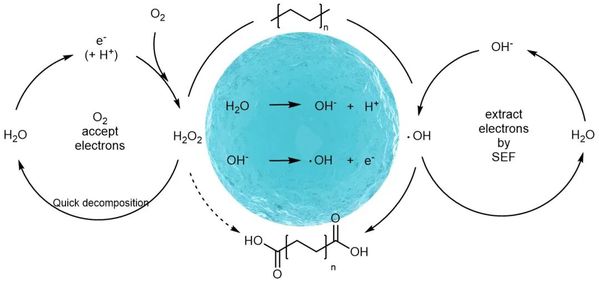
Plastic waste accumulation poses a global threat to both the environment and public health1,2,3. Although catalytic upcycling to value-added chemicals holds promise, its industrial adoption is hindered by additive-induced catalyst deactivation, feedstock heterogeneity, process inflexibility and limited economic viability4. Here we report a catalyst-free upcycling strategy that makes use of in situ generation of hydroxyl radicals at microdroplet interfaces5,6,7,8 to enable oxidative cleavage of diverse waste plastics—from polyolefins to rubbers—into carboxylic acids under mild conditions. By eliminating catalyst-dependent pathways, this approach circumvents key challenges of catalyst design and poisoning, while substantially lowering technical barriers and costs9,10. Our method achieves complete conversion of polyethylene (PE) with selectivity to short-chain diacids approaching 69% under relatively mild conditions and demonstrated broad applicability to mixed commercial plastics, with scalability demonstrated up to the 300-g scale. Radical intermediate analysis reveals the crucial role of H2O in mediating a unique oxidative degradation mechanism: sequential hydroxyl radical addition to alkyl radicals, distinct from classical liquid-phase aerobic oxidation of alkane11. This interfacial radical-mediated strategy enables sustainable polymer upcycling with minimal infrastructure. More broadly, this work provides a scalable blueprint for the first, to our knowledge, industrial implementation of microdroplet chemistry, with transformative implications for oxidation processes in organic acid synthesis and beyond.