2026-10-07 京都大学
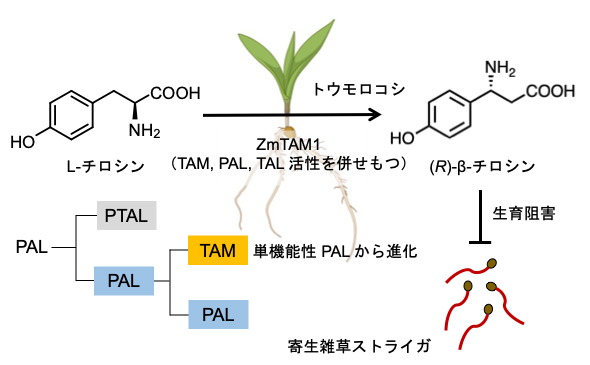
概略図。トウモロコシにおける(R)-β-チロシンとその生合成酵素ZmTAM1の同定。
本図は、https://BioRender.comを用いて作成した。(作成者:阪本駿太)
<関連情報>
- https://www.kyoto-u.ac.jp/ja/research-news/2026-10-07-3
- https://onlinelibrary.wiley.com/doi/10.1111/tpj.71046
トウモロコシの phenylalanine ammonia-lyase は寄⽣雑草 Striga hermonthica に対して⽣育阻害活性を⽰す(R)-β-tyrosineを産⽣する Maize phenylalanine ammonia-lyase produces (R)-β-tyrosine, a growth inhibitor for the parasitic weed Striga hermonthica
Shunta Sakamoto, Masaru Kobayashi, Takanori Yoshikawa, Ryosuke Munakata, Naoko Yoshinaga, Atsushi Okazawa, Takaaki Daimon, Yutaka Sato, Naoki Mori
the Plant Journal Published: 21 July 2026
DOI:https://doi.org/10.1111/tpj.71046
SUMMARY
Tyrosine aminomutase (TAM) and its product, the non-proteinogenic amino acid (R)-β-tyrosine, were previously identified in rice (Oryza sativa L.). Because (R)-β-tyrosine strongly inhibits the growth of dicotyledonous plants, it can be used to enhance crop weed resistance. However, the distribution of TAM and (R)-β-tyrosine remains largely unexplored, even among major grass crops. Here, we investigated their distribution, biosynthetic mechanism, evolutionary history, and potential function in grasses. β-tyrosine was detected in oat (Avena sativa L.) and maize (Zea mays L.) among 22 grass species tested, and chiral analysis revealed it to be predominantly the (R)-enantiomer. Stable isotope labeling confirmed the involvement of TAM in its biosynthesis in maize. A homology search identified a TAM-like gene in maize, Zm00001d033286, previously annotated as phenylalanine ammonia-lyase (PAL). Functional expression of Zm00001d033286 in Nicotiana benthamiana resulted in β-tyrosine production, demonstrating that it encodes TAM (ZmTAM1) and produces (R)-β-tyrosine. Site-directed mutagenesis revealed key residues essential for this activity, and in vitro assays further revealed that ZmTAM1 retains PAL and tyrosine ammonia-lyase (TAL) activities. Phylogenetic analysis suggested that TAM evolved from PAL, not from phenylalanine/tyrosine ammonia-lyase (PTAL). Finally, we demonstrated that (R)-β-tyrosine significantly inhibits the growth of Striga hermonthica, a parasitic weed threatening maize cultivation, at biologically relevant concentrations. Our study shows the sporadic yet phylogenetically broad distribution of TAM in grasses, provides fundamental insights into its potential catalytic mechanism and evolutionary history, and suggests a potential utility of (R)-β-tyrosine in maize defense against parasitic weeds.