2026-10-08 イリノイ大学アーバナ・シャンペーン校
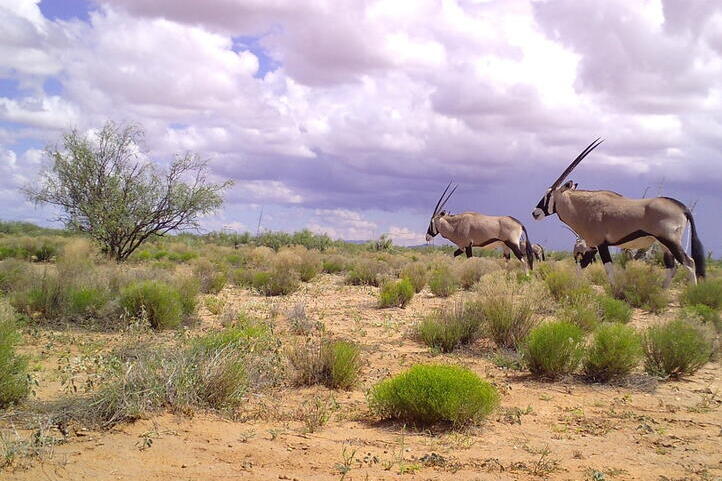
Gemsbok in the Jornada Basin, part of the Chihuahuan Desert in New Mexico. Credit Jornada Basin LTER.
<関連情報>
- https://aces.illinois.edu/news/african-gemsbok-spreading-new-mexico-how-far-could-they-go-under-climate-change
- https://academic.oup.com/jmammal/advance-article/doi/10.1093/jmammal/gyag083/8836738
気候変動下における米国における 外来種オリックス( Oryx gazella ) の生息域拡大予測 Predicted range expansion of exotic Gemsbok (Oryx gazella) under climate change in the United States
Nathan Alexander, Kieran J Andreoni, Robert L Schooley
Journal of Mammalogy Published:26 September 2026
DOI:https://doi.org/10.1093/jmammal/gyag083
Abstract
Climate change is predicted to drastically alter distributions of ungulates with future distributions related to current physiological limitations and habitat associations. The responses of exotic ungulates in arid environments may allow for habitat expansion into previously unoccupied regions due to increasing temperatures and aridity. Here, we use species distribution models to predict habitat suitability for an introduced exotic ungulate, Gemsbok (Oryx gazella), in the southwestern United States, at 2 buffered extents (25 km and 100 km), and then project habitat distributions through 2100 across 3 climate change scenarios. Overall, there was agreement among predictor response curves across models and extents. Temperature seasonality, temperature of the coldest quarter, and human footprint index contributed the most to models. Suitable habitat spans a substantially larger area than the currently occupied distribution of Gemsbok, and we predict increased habitat aggregation and distribution across climate change scenarios. Management of Gemsbok needs to consider future interactions with native ungulates, further research on potential barriers to Gemsbok dispersal, and human perspectives on management strategies.