2026-10-08 カリフォルニア大学サンタクルーズ校(UCSC)
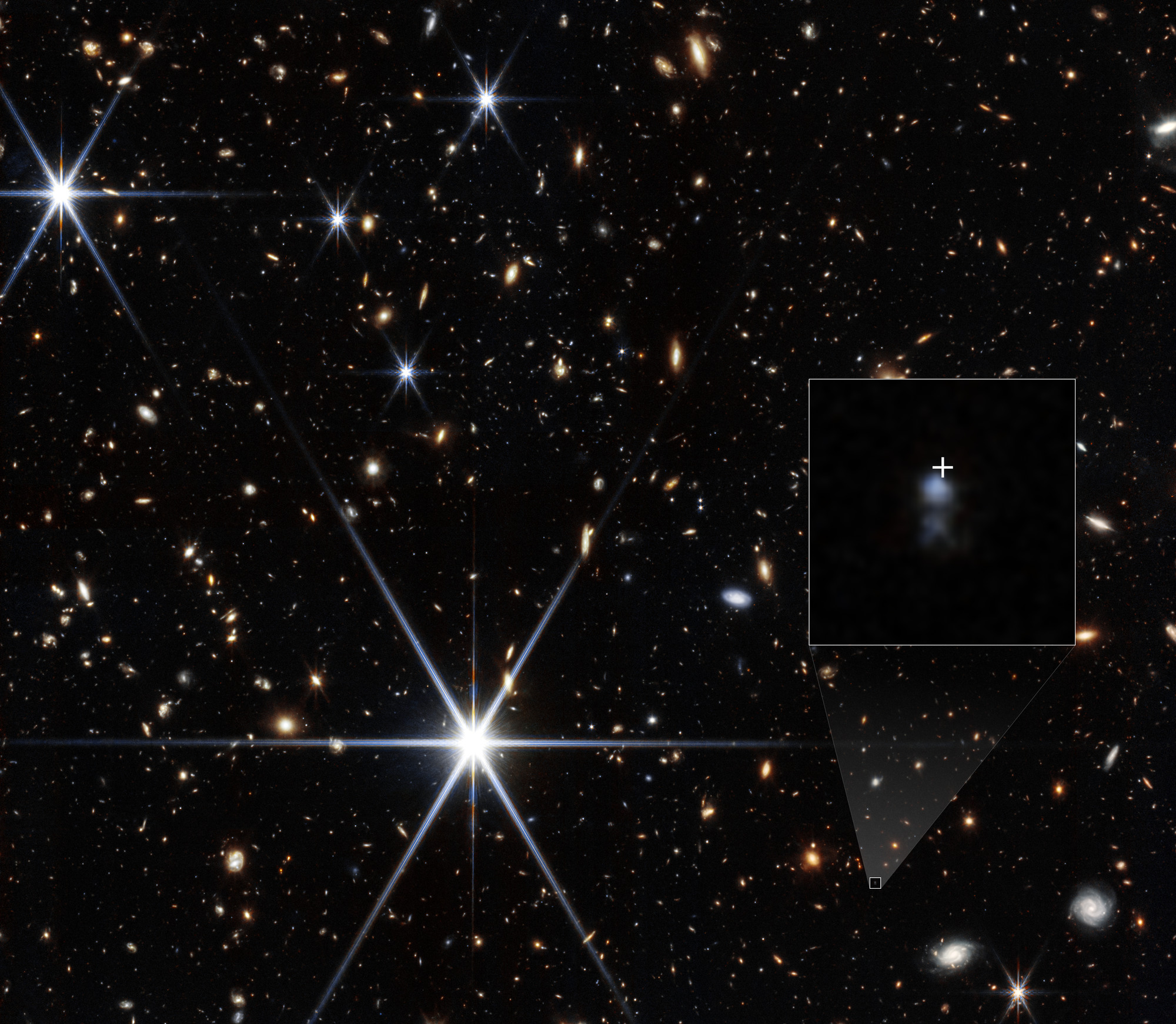
NASA’s James Webb Space Telescope’s Near-Infrared Camera detected the host galaxy of the fast radio burst called FRB 20240304B, whose location is shown by the white cross. It was found in a small dwarf galaxy actively forming stars. Credit: NASA, ESA, CSA, STScI, Themiya Nanayakkara (USYD)
<関連情報>
- https://news.ucsc.edu/2026/10/jwst-farthest-frb/
- https://www.science.org/doi/10.1126/science.adz2675
ビッグバンから30億年後の赤方偏移2における高速電波バースト A fast radio burst at redshift 2, three billion years after the Big Bang
Manisha Caleb, Themiya Nanayakkara, Benjamin W. Stappers, Inés Pastor-Marazuela, […] , and Jun Tian
Science Published:8 Oct 2026
DOI:https://doi.org/10.1126/science.adz2675
Abstract
Fast radio bursts (FRBs) are millisecond-duration radio transients from extragalactic sources. Their frequency and polarization properties are affected by plasma and magnetic fields along the line of sight to Earth. We report radio observations of FRB 20240304B and near-infrared follow-up to identify its host galaxy. The host is a low-mass, clumpy, star-forming galaxy at redshift 2.148 ± 0.0013, corresponding to 3 billion years after the Big Bang. This FRB occurred during the peak of cosmic star formation and probes ionized gas over approximately 80% of cosmic history. The highly scattered burst emission implies that there is a population of FRBs that are undetected by current surveys.