2026-10-08 北海道大学
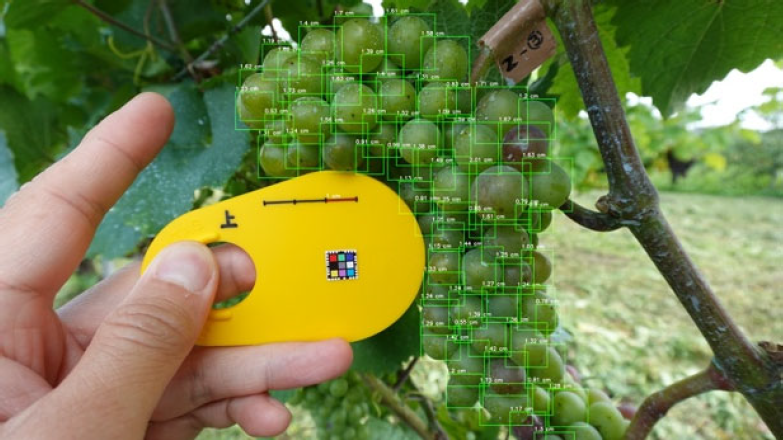
YOLOv8によるブドウ果粒の認識の一例。発達途中のブドウ品種’ツヴァイゲルト’の果房を2024年8月3日に撮影。サイズと色の補正のため、自作したラベル札と一緒に撮影している。The Horticulture Journal誌掲載論文より転載(CC BY-NC 4.0、改変なし)。
<関連情報>
- https://www.hokudai.ac.jp/news/2026/10/ai-13.html
- https://www.jstage.jst.go.jp/article/hortj/95/3/95_SZD-110/_article
YOLOv8とBiology-Informed Smoothingによるブドウ果実のモニタリング手法の確立 Monitoring Relative Grape Berry Growth in the Field with YOLOv8 and Biology-informed Smoothing
Jixiao Li, Teruo Sone, Xiangji Meng, Kentaro Hirayama, Minoru Ikuta, Yoshihisa Inose, Yoichiro Hoshino
The Horticulture Journal Available on J-STAGE: July 15, 2026
DOI:https://doi.org/10.2503/hortj.SZD-110
Abstract
Uncontrolled lighting, occlusion, and variations in viewing angles make it difficult to perform high-frequency, non-destructive monitoring of grape (Vitis vinifera L.) berry growth in the field. Instead of tracking absolute millimeter-level size, a biology-informed pipeline based on YOLOv8 to track relative growth trends is presented. A biology-informed, monotonicity-constrained smoothing step (F-smoothed) is integrated into a workflow that also includes object detection, pixel-to-centimeter conversion using an in-frame 1-cm ruler, preliminary smoothing (outlier removal, interpolation, moving average), and double-sigmoid fitting to summarize phase timing. Images of the ‘Kerner’ and ‘Zweigelt’ clusters in Yoichi, Hokkaido (2024 season; 10 clusters; 1–3-day intervals) were examined as a field case study. On a hold-out validation set, the trained YOLOv8s model demonstrated stable identification (mAP50 = 0.931; mAP50–95 = 0.704; Precision = 0.906; Recall = 0.875). In an independent laboratory validation using detached berries from the 2025 season imaged on a white background, image-derived diameters closely agreed with manual caliper measurements over a range of approximately 0.3–2.3 cm (n = 89; mean absolute error = 0.08 cm; root mean square error = 0.09 cm; mean absolute percentage error = 7.2%; bias = +0.07 cm; R2 = 0.97). Biologically credible trajectories were obtained by applying F-smoothed, averaged cultivar curves followed a double-sigmoid pattern with clear timing features. Such relative temporal indicators are directly relevant for viticultural decisions such as scheduling field inspections and harvest windows and for designing sampling strategies for berry composition and quality. Although destructive sampling of the 2024 field clusters was not undertaken, the combination of a validated measurement module and biology-informed smoothing provides reliable phase timing and relative trend tracking in real-world scenarios. With only a handheld camera and conventional computing, this approach offers a practical methodology for non-destructive growth monitoring that emphasizes temporal dynamics while retaining interpretable links to physical berry size.