2026-10-08 東北大学
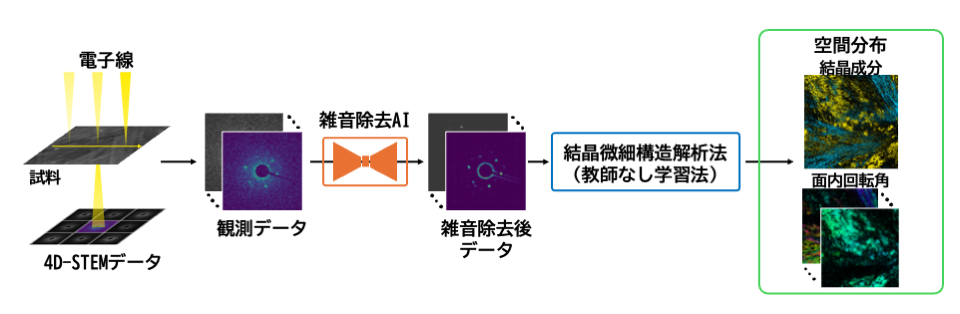
図 1. 本研究で開発した自動解析ワークフロー。4D-STEM データを深層学習モデル(4D-SSD)で雑音除去した後、極座標変換・フーリエ変換した回折図形を教師なし解析して、結晶成分の空間分布と面内回転角の分布を同定する。
<関連情報>
- https://www.tohoku.ac.jp/japanese/2026/10/press20261008-01-unsupervised.html
- https://www.nature.com/articles/s41524-026-02337-x
ノイズの多い4D-STEMデータにおける自動結晶方位マッピングのための教師なし機械学習 Unsupervised machine learning for automated crystal orientation mapping on noisy 4D-STEM data
Kai Kamijo, Motoki Shiga, Shusuke Kanomi, Tomohiro Miyata & Hiroshi Jinnai
npj Computational Materials Published:03 October 2026
DOI:https://doi.org/10.1038/s41524-026-02337-x Early provide
Abstract
Four-dimensional scanning transmission electron microscopy (4D-STEM) is a high-throughput measurement used to comprehensively acquire diffraction patterns across a region of interest in a specimen. While the measurement is useful for identifying crystallographic microstructures, the data analysis requires significant effort owing to the complexity and high dimensionality of the data. Furthermore, the analysis of low signal-to-noise data from beam-sensitive materials such as polymers is particularly challenging. This study proposes an automatic analysis pipeline that leverages denoising and unsupervised crystallographic analysis for 4D-STEM data. The denoising method is based on a self-supervised approach that eliminates the need for clean training images. The developed method is extended to 4D-STEM data by utilizing diffraction patterns observed at neighboring probe positions. The subsequent unsupervised analysis is designed to be invariant to the crystal in-plane rotations, enabling the effective identification of crystal components. The efficacy of the proposed pipeline is evaluated using both synthetic and experimental 4D-STEM data. Quantitative evaluation for synthetic data across various noise levels demonstrates the robustness of our approach. The results from the experimental data show good agreement with expert analysis in the previous study; furthermore, the pipeline identifies minor crystallographic components that were previously overlooked. These results demonstrate that the pipeline enables robust and automated analysis with significantly reduced analysis cost.