2026-10-08 東京科学大学
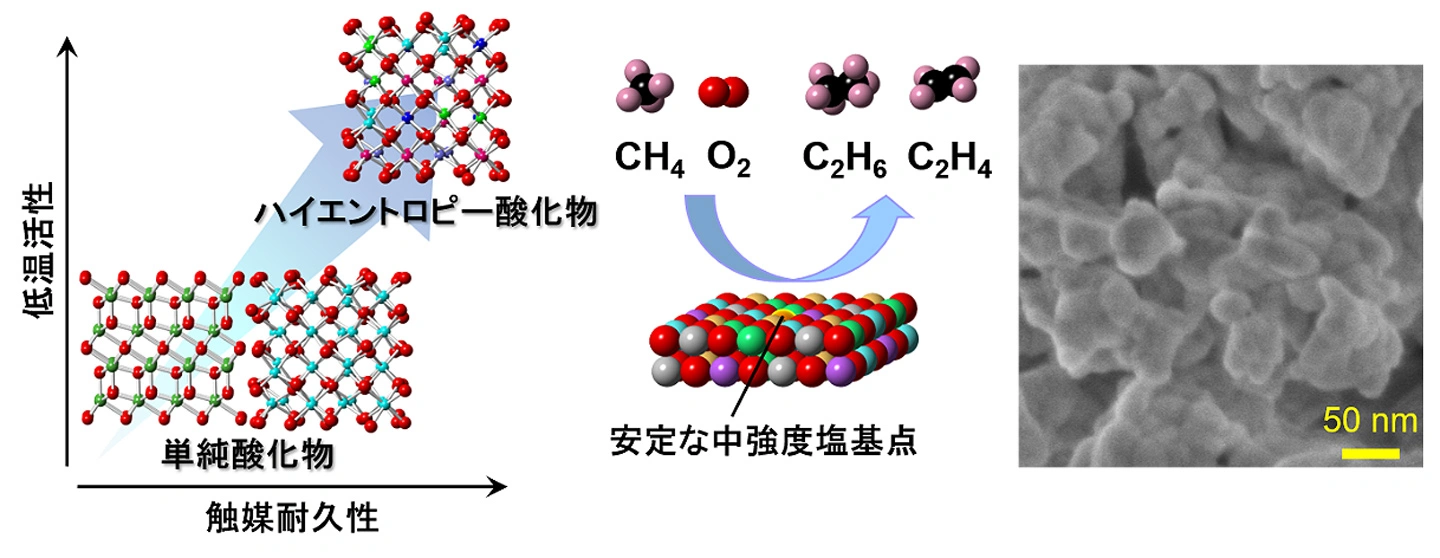
図1. ハイエントロピー酸化物ナノ粒子触媒によるメタン酸化カップリング反応。
<関連情報>
- https://www.isct.ac.jp/ja/news/yei2mj2uz3ru
- https://pubs.acs.org/jacsat/article/doi/10.1021/jacs.6c15276/5446663/High-Entropy-Lanthanoid-Oxide-Catalysts-for
メタンの酸化的カップリングのための高エントロピーランタノイド酸化物触媒 High-Entropy Lanthanoid Oxide Catalysts for Oxidative Coupling of Methane
Rena Takahashi;Keiju Wachi;Keigo Kamata
Journal of the American Chemical Society Published:October 08, 2026
DOI:https://doi.org/10.1021/jacs.6c15276
Abstract
High-entropy engineering of metal oxides provides a powerful platform for developing highly active and structurally robust catalysts; however, its application to heterogenous catalysis that requires stringent selectivity control remains largely unexplored. The low-temperature oxidative coupling of methane (OCM) demands catalysts that combine structural stability with precise tuning of surface basic strength. Here, we report a high-entropy lanthanoid oxide catalyst, (LaSmEuGdDy)0.4O3, synthesized via a sol–gel method using lanthanoid acetates and aspartic acid. The catalyst afforded ethylene and ethane in ∼12.3% total yield at temperatures less than 600 °C and maintained its catalytic activity for 240 h at 600 °C. Comparative studies with single-component lanthanoid oxides revealed that the high-entropy catalyst lowers the OCM onset temperature and markedly enhances catalyst durability. CO2 temperature-programmed desorption demonstrated that the surface basic strength of the high-entropy oxide can be systematically controlled through the average ionic radius, promoting the formation of moderately basic sites essential for low-temperature C–H activation. X-ray diffraction and photoelectron spectroscopy further showed that C-type rare-earth oxides exhibit superior resistance to transformation into less-active Ln2O2CO3 compared with A-type oxides and that the high-entropy configuration mitigates the progressive depletion of surface basic strength during prolonged OCM operation. These findings establish high-entropy design as an effective strategy for simultaneously controlling structural stability and surface functionality, opening new opportunities for selective heterogeneous catalysis.