2026-10-08 東北大学
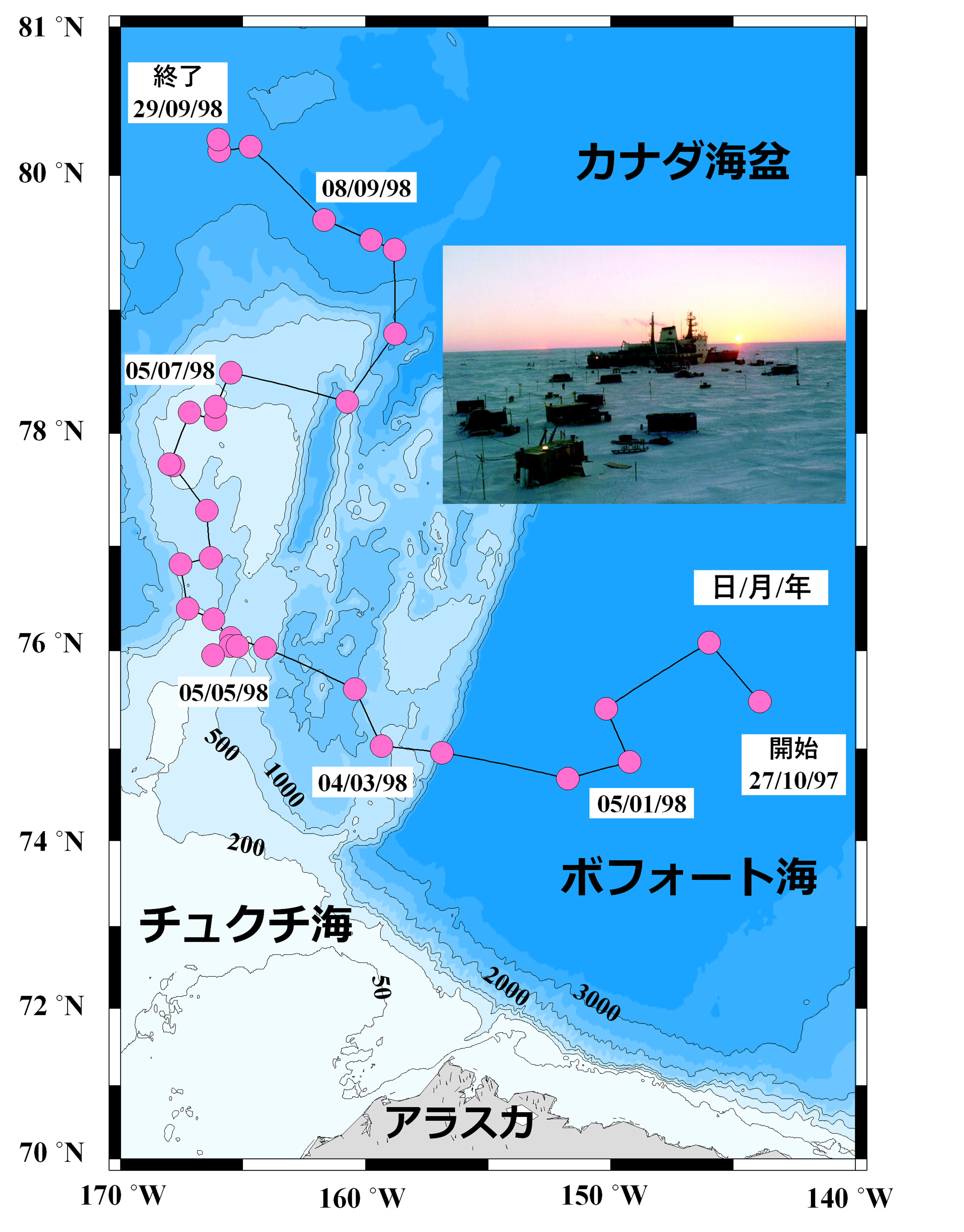
図1. 西部北極海における漂流氷上基地(SHEBA)の移動軌跡と調査位置。1997年10月〜1998年9月にかけ、ボフォート海からカナダ海盆にかけて漂流しながら通年観測が実施された。
<関連情報>
- https://www.tohoku.ac.jp/japanese/2026/10/press20261008-02-longa.html
- https://www.frontiersin.org/journals/marine-science/articles/10.3389/fmars.2026.1864171/full
北極海西部における優占種であるカイアシ類Metridia longaの幼生から成体までの生産量推定値(氷上観測所での年間を通じた観測に基づく) Production estimates of the dominant copepod Metridia longa from nauplii to adults in the western Arctic Ocean, based on year-round observations at an ice station
Yunosuke Koguchi,Dongwoo Kim,Muhammad Izzat Nugraha,Carin J. Ashjian,Robert G. Campbell,Rubao Ji,Goh Nishitani,Atsushi Yamaguchi
Frontiers in Marine Science Published:18 September 2026
DOI:https://doi.org/10.3389/fmars.2026.1864171
Abstract
Most studies on zooplankton ecology in the Arctic Ocean have been conducted during the summer season, and little information is available on their production based on year-round observations. In this study, we estimated the production of a dominant copepod, Metridia longa, from nauplii to adults, based on samples collected at the drifting ice station in the western Arctic Ocean over one year. The vertical distribution of M. longa was shallower in winter than in summer. M. longa showed a one-year generation length and appeared to perform income breeding from May to July. The annual production of M. longa in this region was 424.5 mg DW m–2 year–1, representing 35% of the amount reported for the congeneric species in other regions. The lower annual production may be related to the low primary production under year-round sea-ice cover, although primary production was not measured directly in this study. Ongoing changes in the Arctic Ocean, including a longer sea-ice melting period, may alter the timing of copepod development and production, although this was not directly assessed in the present study. Thus, the results of this study are useful as production data for the dominant copepods in environments under year-round sea ice coverage.