2026-04-14 東北大学
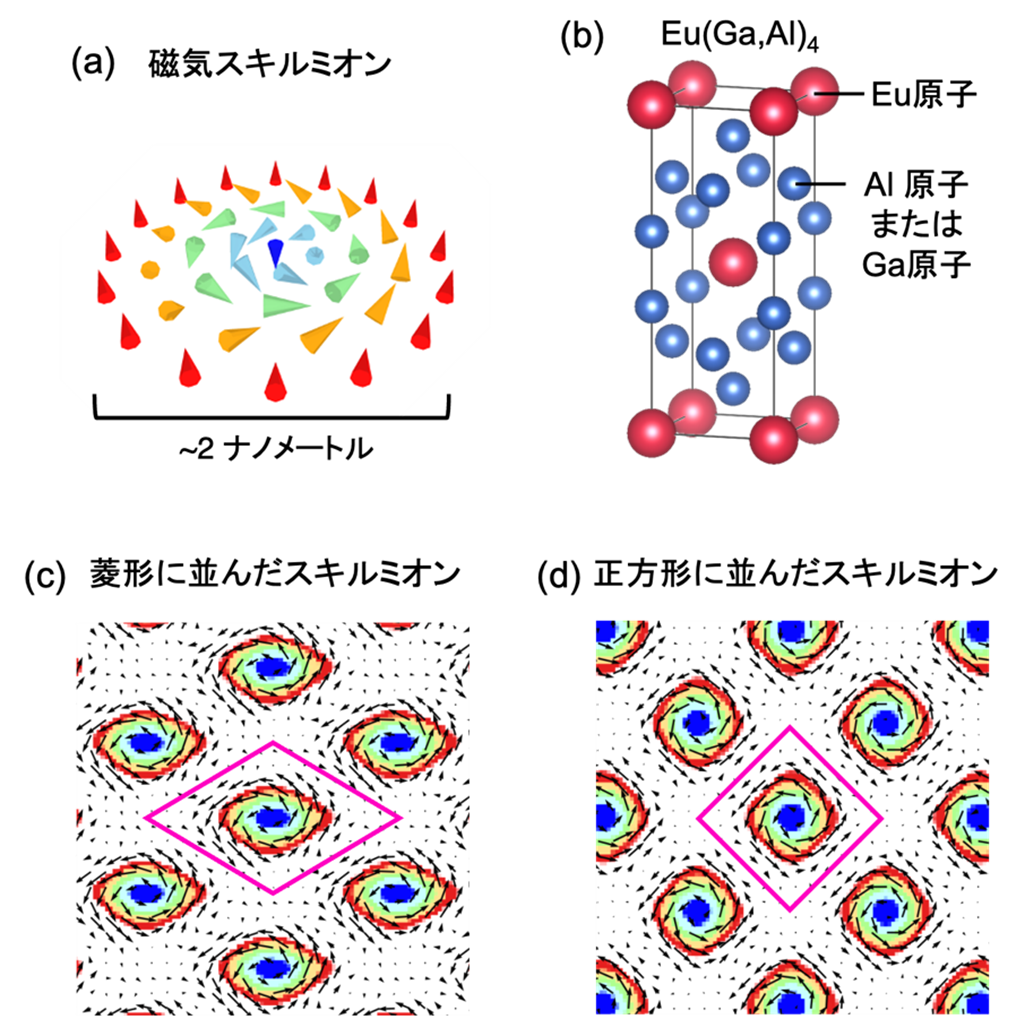
図1.
(a)磁気スキルミオンの模式図。円錐は電子スピンを表し、尖っている方向が磁石のN極に相当する。
(b)Eu(Ga,Al)4の結晶構造の模式図。
(c)スキルミオンが菱形に規則正しく並んだ状態。EuAl4に弱い磁場をかけた際に観測されている。
(d)スキルミオンが正方形に規則正しく並んだ状態。EuAl4に強い磁場をかけた際に観測されている。
<関連情報>
- https://www.tohoku.ac.jp/japanese/2026/04/press20260414-02-nano.html
- https://www.tohoku.ac.jp/japanese/newimg/pressimg/tohokuuniv-press20260414_02web_nano.pdf
- https://www.nature.com/articles/s41467-026-71020-y
EuAl4における複数のスキルミオン相の起源 Origin of multiple skyrmion phases in EuAl4
Yuki Arai,Kosuke Nakayama,Asuka Honma,Seigo Souma,Daisuke Shiga,Hiroshi Kumigashira,Takashi Takahashi,Kouji Segawa & Takafumi Sato
Nature Communications Published:13 April 2026
DOI:https://doi.org/10.1038/s41467-026-71020-y
Abstract
The Dzyaloshinskii-Moriya (DM) interaction has been considered essential for skyrmion formation, however, the discovery of skyrmion lattices (SkLs) in nominally centrosymmetric materials where the DM interaction is forbidden, such as Eu(Ga1−xAlx)4, has challenged this established view. Recent structural investigations of Eu(Ga1−xAlx)4 have further complicated this issue by revealing that the charge-density wave breaks local symmetry, theoretically allowing DM interaction. This raises a fundamental question: are the complex magnetic phases driven by the DM interaction or by alternative mechanisms? Here, using soft-x-ray angle-resolved photoemission spectroscopy, we determine the three-dimensional bulk electronic structure of Eu(Ga1−xAlx)4, and elucidate the electronic origins of its rich magnetic orders. We directly observe an x-dependent Lifshitz transition leading to the emergence of a Fermi-surface pocket. Importantly, multiple nesting vectors derived from this pocket match the symmetries and periodicities of the multiple SkLs. Moreover, these nesting vectors can also account for other magnetic orders, such as the zero-field helical magnetism, suggesting a common electronic origin of the complex magnetic phases. These findings suggest that competing nesting-induced Ruderman-Kittel-Kasuya-Yosida interactions and their engineering can generate and control various SkLs and related topological spin textures.