2026-06-12 早稲田大学
◆研究では、単一マグノンだけでなく、複数のマグノンが強く結合した束縛状態との相互作用を高精度に扱う「再和法(resummation)」を導入した新理論を構築した。その結果、臭化クロム(CrBr₃)で観測されていた中性子散乱実験の温度依存スペクトルを再現し、従来理論では説明できなかったマグノンのエネルギー変化や線幅拡大の起源を明らかにした。さらに、ヨウ化クロム(CrI₃)では、トポロジカル性を特徴づけるバンドギャップがキュリー温度近傍まで維持されることを示し、トポロジカルマグノンが従来予想よりも高温まで頑健であることを実証した。また、実用材料探索の指標として、Dzyaloshinskii-Moriya相互作用と交換相互作用の比(D/J)が約5%以上必要であることも示した。
◆本成果は、超低消費電力スピントロニクスや次世代量子情報デバイス向け材料設計の重要な理論基盤となる。
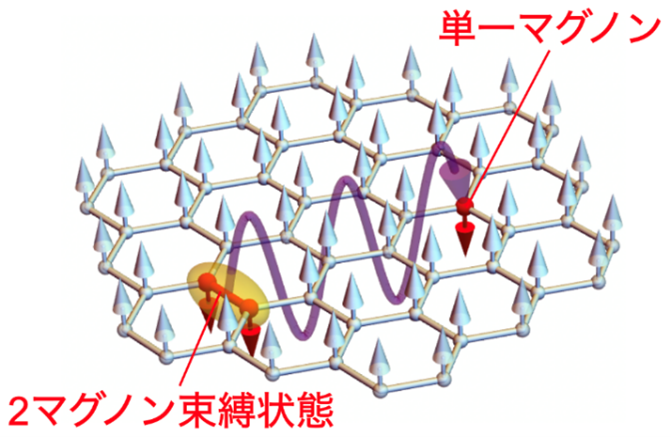
図1: 磁性元素が蜂の巣(ハニカム)格子を組むファンデルワールス強磁性体の模式図。2つのマグノンの束縛状態[図中左]が、単一マグノン[図中右]と相互作用する様子を示している
<関連情報>
- https://www.waseda.jp/inst/research/news/84678
- https://journals.aps.org/prx/abstract/10.1103/tbh2-jq9r
有限温度におけるファンデルワールス強磁性体中のトポロジカルディラックマグノンの運命 Fate of Topological Dirac Magnons in van der Waals Ferromagnets at Finite Temperature
Rintaro Eto, Ignacio Salgado-Linares, Masahito Mochizuki, Johannes Knolle, and Alexander Mook
Physical Review X Published: 10 June, 2026
DOI: https://doi.org/10.1103/tbh2-jq9r
Abstract
Dirac magnons, the bosonic counterparts of Dirac fermions in graphene, provide a versatile platform to explore symmetry-protected band crossings and quantum geometry in magnetic insulators while promising high-velocity, low-dissipation spin transport for next-generation magnonic technologies. However, their stability under realistic, finite-temperature conditions remains an open question. Here, we develop a microscopic theory of thermal magnon-magnon interactions in van der Waals honeycomb ferromagnets, focusing on both gapless and gapped Dirac magnons. Using nonlinear spin-wave theory with magnon self-energy corrections and a T-matrix resummation that captures two-magnon bound states, we quantitatively reproduce temperature- and momentum-dependent energy shifts and linewidths observed experimentally in the gapless Dirac magnon material CrBr3, even near the Curie temperature. Our approach provides a consistent interpretation of theoretical predictions and experiment shedding light on the role of bound states in enhancing magnon damping at low temperatures. For gapped Dirac magnon materials such as CrI3, CrSiTe3, and CrGeTe3, we find a thermally induced reduction of the topological magnon gap, while no indication of thermally driven topological phase transitions is observed within the considered parameter range. Classical atomistic spin-dynamics simulations corroborate the gap’s robustness up to the Curie temperature. Furthermore, we establish a practical criterion for observing topological gaps by determining the minimum ratio of Dzyaloshinskii-Moriya interaction to Heisenberg exchange required to overcome thermal broadening throughout the ordered phase, typically around 5%. Taken together, our results elucidate the interplay between thermal many-body effects and topology in low-dimensional magnetic systems and provide a controlled framework for the interpretation of spectroscopic measurements.