2026-06-12 広島大学
◆研究では、リュウグウ粒子を室温(20~23℃)、相対湿度30~40%の大気中に曝露し、電子顕微鏡や放射光X線分光法で解析した。その結果、粒子中に広く含まれる磁硫鉄鉱(pyrrhotite)が最初に酸化し、鉄・酸素に富むアモルファス変質層を形成することが判明した。この酸化反応により局所的に酸性・酸化的環境が生じ、周囲のフィロケイ酸塩や有機物にも連鎖的な変質が発生した。磁硫鉄鉱の初期変質速度は約0.1nm/日と見積もられ、一般的な窒素雰囲気や乾燥空気中での保管でも変質が進行し得ることが示された。
◆本研究は、リュウグウやベンヌ、将来のフォボス・火星帰還試料の科学的価値を保持するためには、低温・低酸素・低湿度を組み合わせた厳格な保存環境が必要であることを示した。成果は『Nature Communications』に掲載された。
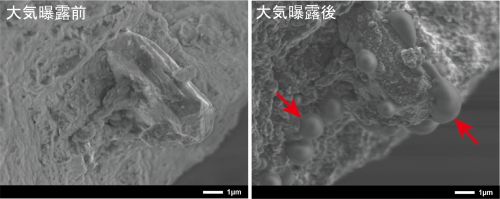
図1.大気曝露前後の磁硫鉄鉱の電子顕微鏡写真.赤い矢印は、磁硫鉄鉱の酸化によってできた鉄と酸素に富む変質物を示す。
<関連情報>
リュウグウの岩石粒子における磁硫鉄鉱によって引き起こされる初期段階の地殻変質 Pyrrhotite-driven early-stage terrestrial alteration in Ryugu grains
Masaaki Miyahara,Takaaki Noguchi,Toru Matsumoto,Naotaka Tomioka,Tohru Araki,Akira Miyake,Yohei Igami,Yusuke Seto & Akira Yamaguchi
Nature Communications Published:29 May 2026
DOI:https://doi.org/10.1038/s41467-026-73875-7 Unedited version
Abstract
Samples returned from the carbonaceous asteroid Ryugu preserve a rare record of water- and organic-rich materials from the early Solar System, but this record can be modified rapidly after arrival on Earth. Here we show through controlled atmospheric exposure experiments that Ryugu grains undergo measurable terrestrial alteration within weeks to months. Pyrrhotite develops Fe–O-rich amorphous rims through oxidation and sulfur loss, while adjacent phyllosilicates become amorphized and carbonaceous materials form nanoscale bubbles and carbon–oxygen–rich surface precipitates. X-ray absorption spectroscopy reveals partial oxidation of Fe and S and chemical modification of associated organic matter. From the thickness of pyrrhotite alteration rims, we estimate an early-stage alteration rate of ~0.1 nm per day under low-humidity laboratory conditions. These results identify pyrrhotite as a key trigger of coupled mineral and organic alteration and show that even moderate terrestrial exposure can compromise volatile-rich, fine-grained astromaterials. Our findings provide an empirical basis for cold curation of returned samples.