2026-06-05 東京大学,産業技術総合研究所,筑波大学,大阪大学,科学技術振興機構
◆従来のMoS₂ナノチューブは多層構造かつ直径が大きく、原子配列やサイズの制御が困難だった。本研究ではBNNT内部を反応場として利用することで、原子レベルで整った単層ナノチューブを高収率で形成した。電子顕微鏡観察により、直径2nm以下、最小1nmの同軸構造を確認し、極小径ではアームチェア型原子配列が選択的に形成されることを明らかにした。さらに電子エネルギー損失分光法により、ナノチューブ径が小さくなるほどバンドギャップが縮小することを実験的に実証し、約25年前から予測されていた理論を初めて検証した。
◆MoS₂ナノチューブを絶縁体BNNTが包む同軸構造は、次世代のGate-all-around(GAA)型トランジスタのチャネル構造に対応しており、低消費電力半導体や新規量子デバイスへの応用が期待される。
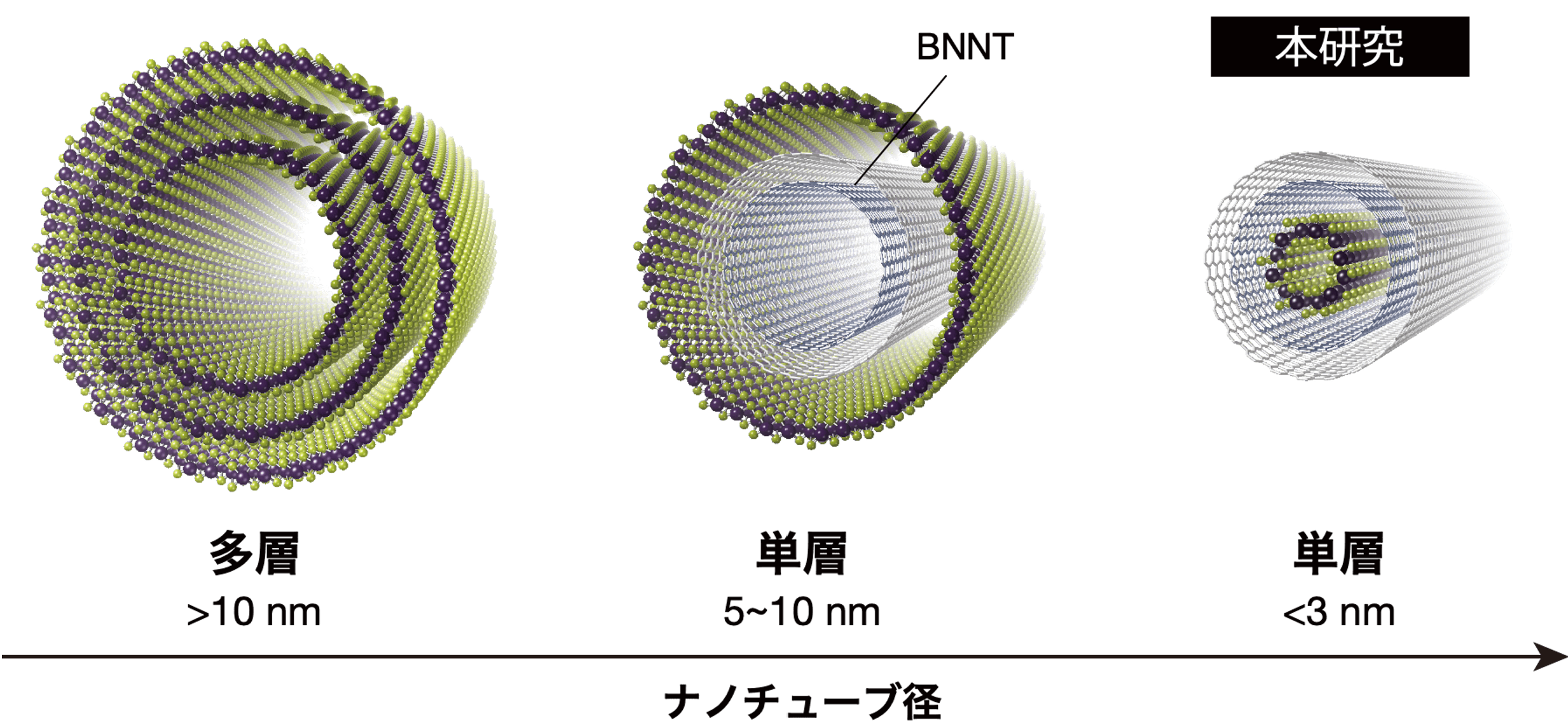
図1:MoS2ナノチューブの径縮小と本研究の位置付け
従来のTMDナノチューブは多層構造(10 nm以上)が主流であり、近年、BNNTやカーボンナノチューブの外壁をテンプレートに利用した単層化(5〜10 nm)が進展してきた。本研究ではBNNTの内部空間を利用し、さらに小径(数ナノメートル以下)の単層ナノチューブを実現した。
<関連情報>
- https://www.k.u-tokyo.ac.jp/information/category/press/0030083.html
- https://www.science.org/doi/10.1126/science.aee3446
アームチェア型MoS₂ナノチューブの1nm限界における限定成長 Confined growth of armchair MoS2 nanotubes at the 1-nm limit
Yusuke Nakanishi, Ryosuke Senga, Shinpei Furusawa, Yuta Sato, […] , and Kazu Suenaga
Science Published:4 Jun 2026
DOI:https://doi.org/10.1126/science.aee3446
Editor’s summary
Atomically thin semiconductors offer opportunities for nanoscale electronics, but controlling their structure remains challenging. Nakanishi et al. synthesized single-walled molybdenum disulfide nanotubes with diameters approaching 1 nanometer by confining growth inside boron nitride nanotubes. Using electron microscopy and spectroscopy, they identified a strong “armchair” preference and a systematic decrease in bandgap with diameter of the nanotubes. Additionally, they showed that the boron nitride sheath not only helps stabilize the highly curved molybdenum disulfide tubes but also provides an intrinsic gate-all-around geometry, offering potential for next-generation nanoscale electronics. — Jack Huang
Abstract
Atomically thin nanotubes of semiconducting transition metal dichalcogenides offer a platform for exploring quantum phenomena at the one-dimensional limit and for realizing nanoscale transistor channels. However, conventional syntheses produce only large-diameter (>10 nm), multiwalled tubes with uncontrolled chiralities. We report the synthesis of single-walled molybdenum disulfide (MoS2) nanotubes with diameters approaching 1 nm, achieved through spatially confined reactions inside boron nitride (BN) nanotubes. The confined geometry stabilizes otherwise inaccessible, highly strained MoS2 nanotubes, yielding structurally well-defined armchair configurations. Their bandgaps shrink systematically with decreasing diameter, in accordance with long-standing theoretical predictions. The insulating BN sheath simultaneously provides an intrinsic gate-all-around architecture, thereby promising access to truly nanoscale transistor channels.