2026-06-12 京都大学
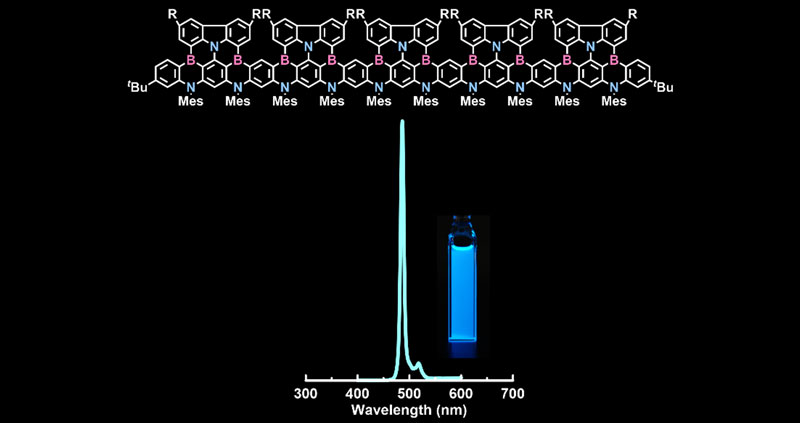
本研究で開発した含BNナノカーボン多重共鳴分子の構造と発光スペクトル(作成:儘田正史)
<関連情報>
- https://www.kyoto-u.ac.jp/ja/research-news/2026-06-12
- https://www.science.org/doi/10.1126/science.aee0001
有機物の自然放出が単色限界に近づく Organic spontaneous emission approaching the monochromatic limit
Masashi Mamada, Kota Kataoka, Junki Ochi, Taehwan Lee, […] , and Takuji Hatakeyama
Science Published:11 Jun 2026
DOI:https://doi.org/10.1126/science.aee0001
Editor’s summary
Narrowing the spontaneous emission spectrum of organic emitters remains a major challenge, particularly addressing disorder-induced inhomogeneous broadening. Mamada et al. report an organic molecule composed exclusively of carbon, hydrogen, nitrogen, and boron atoms that, through a modular multiple-resonance design, exhibits ultranarrow spontaneous emission, achieving a linewidth of just 6.9 nanometers in toluene. This pushes the physical limits of spontaneous emission linewidths in organic materials. The compound demonstrates suppressed vibronic coupling and minimal nonradiative recombination, with a delayed lifetime of less than 500 nanoseconds. These remarkable properties open new horizons for organic luminescent materials and pave the way for innovations in displays, optical communications, spectroscopy, photochemical reactions, bioimaging, and phototherapy. —Yury Suleymanov
Abstract
Spontaneous emission is inherently associated with spectral broadening mechanisms, resulting in finite bandwidth in the emitted light. Narrowing this linewidth toward the monochromatic limit has long been a central pursuit in photonics, as it determines the ultimate color purity of nonstimulated light sources. Organic luminescent materials offer facile wavelength tunability but typically exhibit broad emission bands (>40 nanometers). The emergence of multiple-resonance emitters has provided a promising route to overcome this limitation, yet most reported systems remain within 20 to 30 nanometers. We present a molecular design strategy that amplifies the multiple-resonance effect through molecular repetition, yielding fluorescence with linewidths of 6.9 nanometers in toluene, 5.5 nanometers in 3-methylpentane, and 9.1 nanometers in a doped polymer film, placing this molecular framework among the narrowest-band organic luminophores reported.