2026-04-07 北海道大学,九州大学,名古屋大学
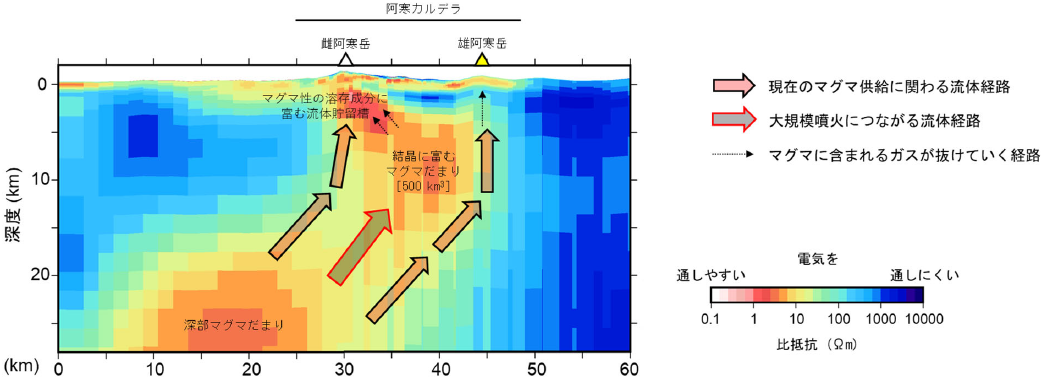
本研究で提案した阿寒カルデラのマグマシステム
<関連情報>
- https://www.hokudai.ac.jp/news/2026/04/post-2243.html
- https://www.hokudai.ac.jp/news/pdf/260407_pr.pdf
- https://link.springer.com/article/10.1186/s40623-026-02398-8
北海道・阿寒カルデラにおける高密度マグネトテルリック法イメージング:マグマ供給系とカルデラ形成マグマだまりへの示唆 Dense magnetotelluric imaging of the Akan Caldera (Hokkaido, Japan): insights into its magma plumbing system and caldera-forming reservoir
Tomohiro Inoue,Takeshi Hashimoto,Koki Aizawa,Hiroshi Ichihara,Ryo Tanaka & Yusuke Yamaya
Earth,Plants & Space Published:16 March 2026
DOI:https://doi.org/10.1186/s40623-026-02398-8 Unedited version
Abstract
To investigate the magma plumbing system beneath the Akan Caldera (Hokkaido, Japan), we conducted broadband magnetotelluric surveys and imaged its three-dimensional resistivity structure to a depth of approximately 30 km. The caldera hosts post-caldera volcanoes, including Mt. Meakandake and Mt. Oakandake, which have recently shown ground inflation and heightened deep low-frequency seismicity. Our main finding is a prominent, westward-dipping conductive column beneath the caldera. This conductor is interpreted as the magma plumbing system of the Akan Caldera, comprising three distinct components, for which we estimated volumes based on the spatial extent of the conductive region: (1) the volatile-rich zone at depths of 2–5 km (~ 10 km3, < 10 Ωm), (2) a mushy dacitic magma reservoir beneath the caldera center at depths of 3–15 km (~ 500 km3, < 10 Ωm), and (3) a deeper basaltic magma reservoir to the west at depths of 15–30 km (~ 4500 km3, < 70 Ωm). The active volcanoes, deformation sources, and earthquake hypocenters are located above or near the conductor edges (2), suggesting that magmatic fluids from the deeper western source (3) preferentially ascend along the column edges. A distinctive feature of the caldera is the flattened upper boundary of conductor (2), which is associated with sill-shaped ground inflation. This geometry may indicate the potential to store large volume of mushy magma, which could become eruptible if magma is directly supplied from greater depths. This study provides new insights into the magma plumbing system beneath the Akan Caldera and enhances our understanding of the mechanisms underlying its volcanic activity.