2026-04-23コロンビア大学
<関連情報>
- https://news.climate.columbia.edu/2026/04/23/in-eastern-africa-the-cradle-of-humankind-is-tearing-apart/
- https://www.nature.com/articles/s41467-026-71663-x
活発なトゥルカナ地溝帯の狭窄と、東アフリカ大陸分裂に向けた準備 Necking of the active Turkana Rift Zone and the priming of eastern Africa for continental breakup
Christian M. Rowan,Folarin Kolawole,Anne Bécel,Paul Betka & John Rowan
Nature Communications Published:23 April 2026
DOI:https://doi.org/10.1038/s41467-026-71663-x
Abstract
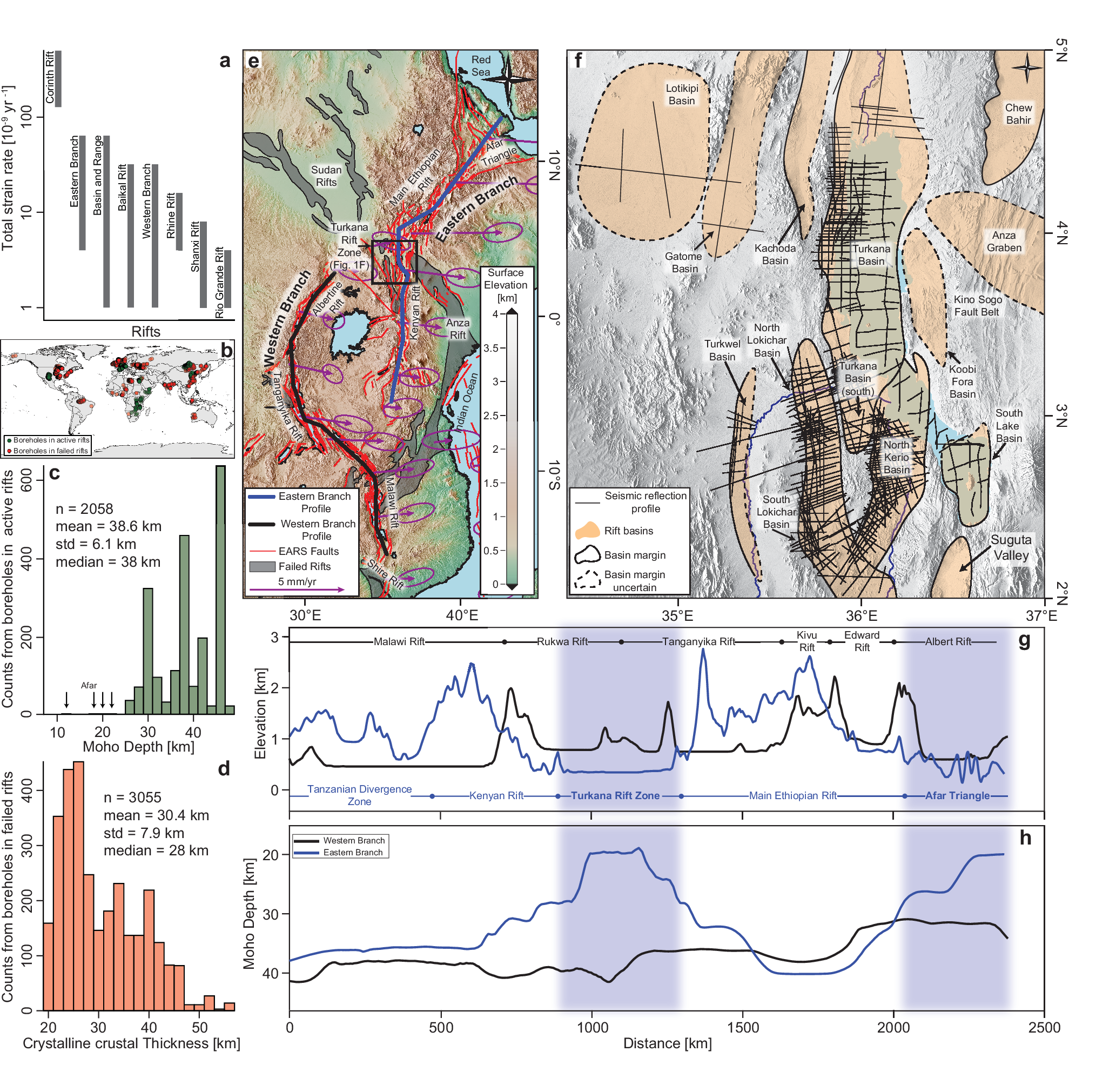
Continental rifting initiates the transition to breakup when the crust is necked and deformation localizes at the rift axis. However, the slow crustal-stretching rates and >20-km deep mantle beneath many active rifts worldwide suggest that present-day breakup may not be imminent. High-resolution seismic data from the Turkana Rift Zone of the East African Rift System (EARS) reveal the rift’s subsurface structure. Here, we show that Turkana’s crystalline crust has thinned to ~13 km along the rift axis, revealing an active rift undergoing crustal necking. Onset of necking is constrained to ~4 Ma and facilitated the accumulation of Turkana’s world-famous fossil record of human evolution. Identification of necking in the EARS indicates that eastern Africa is primed for continental breakup.