2026-05-25 京都工芸繊維大学
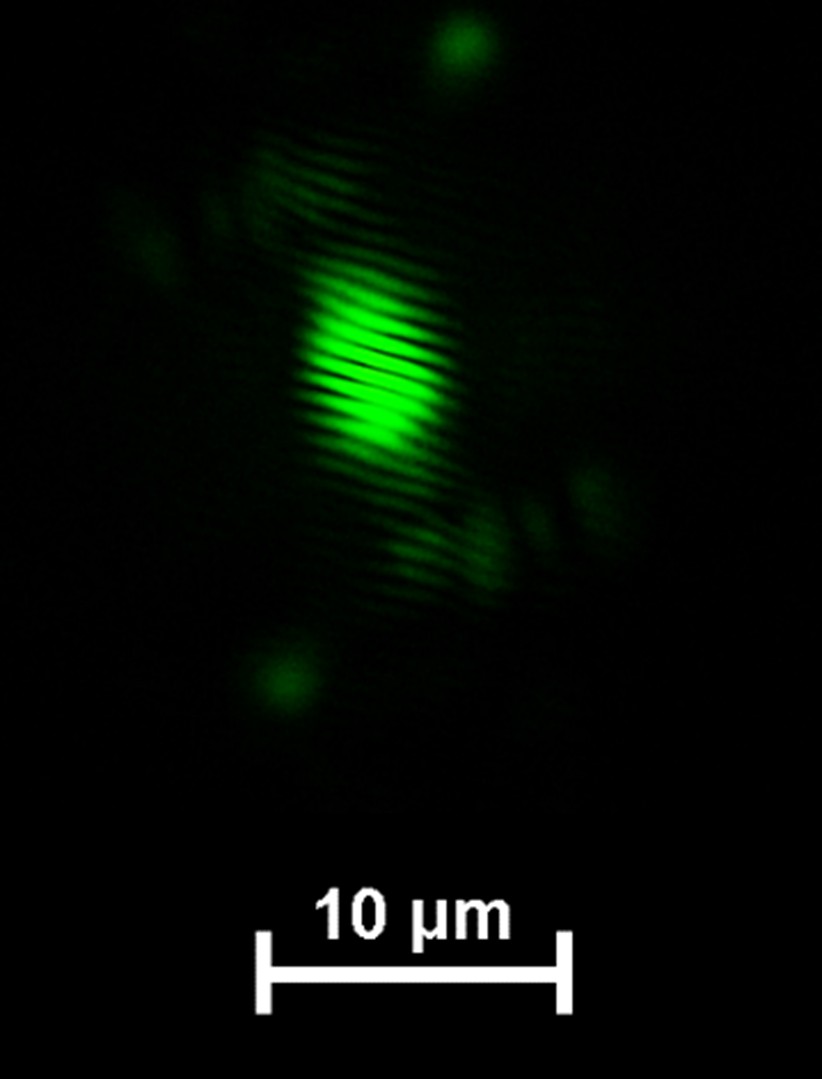
ポラリトンからの発光の顕微鏡写真。
スピノール凝縮示す量子干渉を示している。
<関連情報>
- https://www.kit.ac.jp/2026/05/news260525/
- https://www.kit.ac.jp/wp/wp-content/uploads/2026/05/news260525.pdf
- https://www.science.org/doi/10.1126/sciadv.aeb1521
ハロゲン化物ペロブスカイトマイクロキャビティにおける室温スピノール凝縮体 Room-temperature spinor condensate in halide perovskite microcavity
Takaya Inukai, Ryohei Shibano, Taiki Ogura, Tohki Inoue, […] , and Kenichi Yamashita
Science Advances Published:22 May 2026
DOI:https://doi.org/10.1126/sciadv.aeb1521
Abstract
A deeper understanding of room temperature polariton condensed phases is essential for advancing quantum applications. Spin degrees of freedom inherent in polariton particles manifest themselves in the form of spinor condensation, which has been demonstrated only at cryogenic temperatures in the past. Herein, we demonstrate room-temperature spinor polariton condensation in a lead-halide perovskite microcavity under nonresonant optical excitation. The crystalline anisotropy of the perovskite induces a linear polarization splitting of the lower polariton modes, and, above the condensation threshold, nonlinear polariton-polariton interactions drive the formation of elliptically polarized condensates. The condensation dynamics are analyzed using a spin-dependent Gross-Pitaevskii model, which provides a qualitative framework for understanding the experimentally observed polarization evolution and two-stage threshold behavior. Our findings pave the way for all-optical control of polariton spin states at room temperature, opening a path toward scalable polaritonic quantum devices.