2026-05-22 日本原子力研究開発機構
<関連情報>
- https://www.jaea.go.jp/02/press2026/p26052202/
- https://www.tandfonline.com/doi/full/10.1080/00223131.2026.2637453
実際の核燃料由来溶液からの放射線分解による水素生成量に対する温度の 影響 Effect of temperature on radiolytically generated hydrogen yield from actual nuclear fuel-derived solution
Tomohiro Toigawa,Shinobu Hotoku,Yuta Kumagai,Yuma Abe,Kan-ichi Oyama,Hiroyuki Fukaya,…
Journal of Nuclear Science and Technology Published:18 May 2026
DOI:https://doi.org/10.1080/00223131.2026.2637453
ABSTRACT
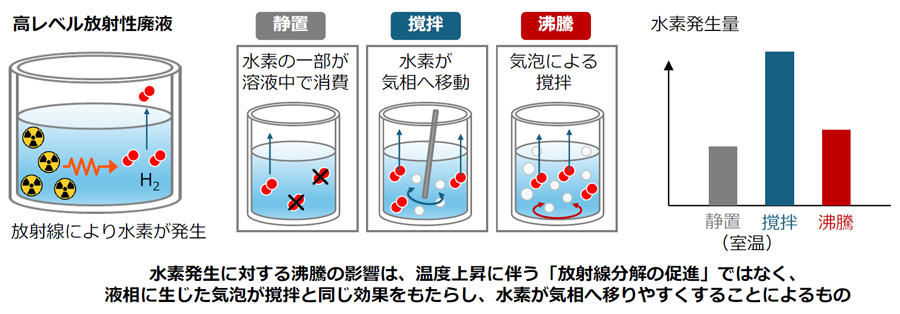
The effect of temperature on hydrogen generated from radiolysis was investigated to determine the safety implications in nuclear fuel reprocessing, particularly in cases involving loss of cooling for high-level radioactive solutions. Radiolytic hydrogen production poses a risk due to its flammability, especially when it accumulates in confined spaces without ventilation. Herein, generation of radiolytic hydrogen from an actual nuclear fuel-derived solution is investigated. Compared to previous studies using a plutonium nitric acid solution, this study evaluates radiolytic hydrogen yield under more realistic conditions, reflecting post-irradiation fuel composition. G-values of H2 are determined at multiple temperatures, and the impact of alpha, beta, and gamma radiation doses is evaluated using PHITS-based simulations. Findings from this study confirmed a reduction in hydrogen yield due to scavenging effects of high-concentration nitric acid and metal ions dissolved in the solution, and temperature dependence appeared to be minor. A weak decreasing trend of G-values with temperature under agitated conditions might be related to hydrogen consumption by palladium species.