2026-10-05 森林総合研究所
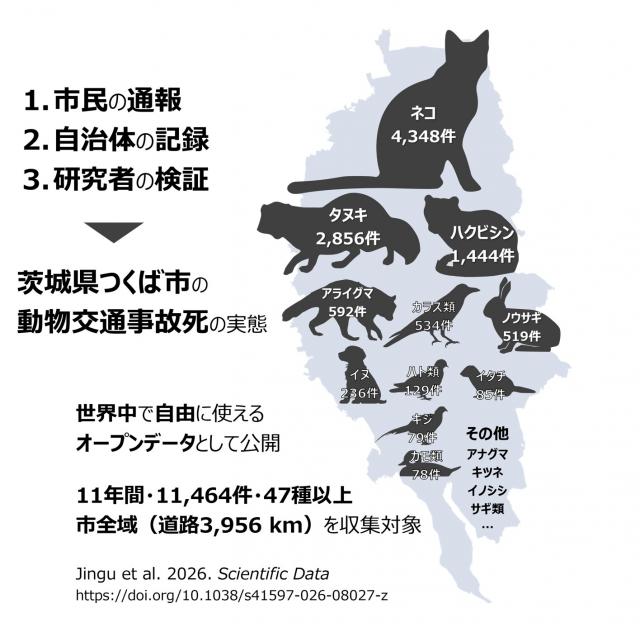
図1 本研究の主要結果の概要
<関連情報>
- https://www.ffpri.go.jp/press/2026/20261005/index.html
- https://www.nature.com/articles/s41597-026-08027-z
日本のつくば市における11年間の時空間的な交通事故死データセット An 11-year spatiotemporal roadkill dataset from Tsukuba, Japan
Shoma Jingu, Minami Unno, Yui Ogawa, Ryota Aizawa, Keisuke Yamamoto, Tomoro Mukai, Saya Sunada & Yuya Watari
Scientific Data Published:05 August 2026
DOI:https://doi.org/10.1038/s41597-026-08027-z Early provide
Abstract
Roadkill data are vital for assessing biodiversity and human–wildlife conflicts. Although an increasing number of roadkill datasets have become available globally, most are constrained by sampling along major highways, lack missing-data mechanism quantification, and are geographically biased toward Western countries. This Data Descriptor presents a comprehensive dataset of 14,249 roadkill records spanning 47 taxonomic categories collected over 11 years (2005–2007 and 2016–2025) in Tsukuba City, Japan. Unlike traditional surveys, this dataset was generated through an “unintended citizen science,” in which citizens report carcasses to the municipal administration, triggering collection by contracted professionals. These administrative records were then validated by experts for taxonomic accuracy and structured into a standardized format. This mechanism ensured comprehensive coverage of the entire 284 km² administrative area. This standardized dataset features three strengths: (1) provision of a complete, spatially accurate, long-term record of carcasses across the study area; (2) retainment of invalid reports, enabling estimation of the number of roadkill records typically excluded from comparable citizen-science studies; and (3) inclusion of species identifications from citizens, technicians, and scientists, allowing assessment of the reliability of citizen-provided data. The dataset offers a baseline for modeling species distributions, analyzing the impacts of urbanization, monitoring the invasion of non-native species, mitigating wildlife-vehicle collisions, and evaluating the reliability of other biodiversity monitoring systems based on similar administrative procedures.