2026-11-02 琉球大学
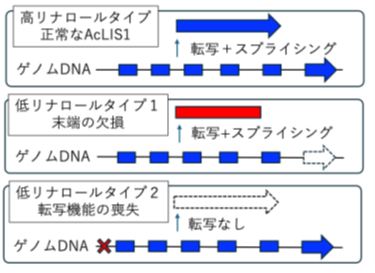
図1. AcLIS1に見られるゲノムタイプ(対立遺伝子)とリナロール合成能力の関係
<関連情報>
- https://www.u-ryukyu.ac.jp/news/98309/
- https://academic.oup.com/hr/advance-article/doi/10.1093/hr/uhag443/8944110
全ゲノム解析により、AcLIS1の構造変異とAcAAT1の重要な残基変異がパイナップルのリナロール、エステル、ラクトン組成を決定づけている ことが明らかになった Pan-genomic analysis reveals structural variations in AcLIS1 and a key residue variation in AcAAT1 driving pineapple linalool, ester, and lactone profiles
Kenji Nashima , Yonathan Asikin , Yusuke Kamiyoshihara , Wataru Hakamata , Kenta Shirasawa , Koji Wada , Yuta Omine , Ryota Maekawa , Takuya Kobayashi , Makoto Takeuchi, …
Horticulture Research Published: 20 October 2026
DOI:https://doi.org/10.1093/hr/uhag443
Abstract
Pineapple (Ananas comosus) exhibits a diverse array of aromatic profiles—ranging from “Peach” and “Coconut” to “Sweet/Fruity” and “Floral/Citrus”—which are critical for consumer preference. However, the genetic and molecular mechanisms governing these key volatiles have remained largely elusive. In this study, we elucidated the genetic architecture of pineapple aroma by combining QTL mapping in an F1 population (N = 87) with a locus-specific pan-genome reference integrating 11 de novo genome assemblies. We identified two key candidate genes, alcohol acyltransferase 1 (AcAAT1) and the linalool synthase 1 (AcLIS1) genes, associated with these aromatic traits. Pan-genomic analysis revealed six distinct haplotypes at the AcLIS1 locus, where structural truncations and large insertions/deletions (INDELs) are associated with the low-linalool phenotype. For ester and lactone accumulation, we pinpointed AcAAT1-1 as the strong candidate gene. Enzymatic assays validated the esterification activity of AcAAT-1 variants, while molecular dynamics simulations predicted that a single amino acid residue at position 405 acts as a potential molecular switch influencing substrate specificity and pocket architecture. Structural modeling predicted that a bulky Phenylalanine (F405) optimizes the active site for aliphatic ester production, whereas a small Glycine (G405) accommodates lactone biosynthesis, and a Cysteine (C405) restricts substrate access. By integrating these findings, we propose a model where the interplay between AcAAT1 and AcLIS1 haplotypes is associated with distinct volatile profiles. Our results illustrate how structural variations and active-site residue substitutions have shaped the metabolic diversification of pineapple aroma, providing molecular insights and haplotype-specific markers for marker-assisted selection in pineapple breeding.