2026-10-30 デラウェア大学(UD)
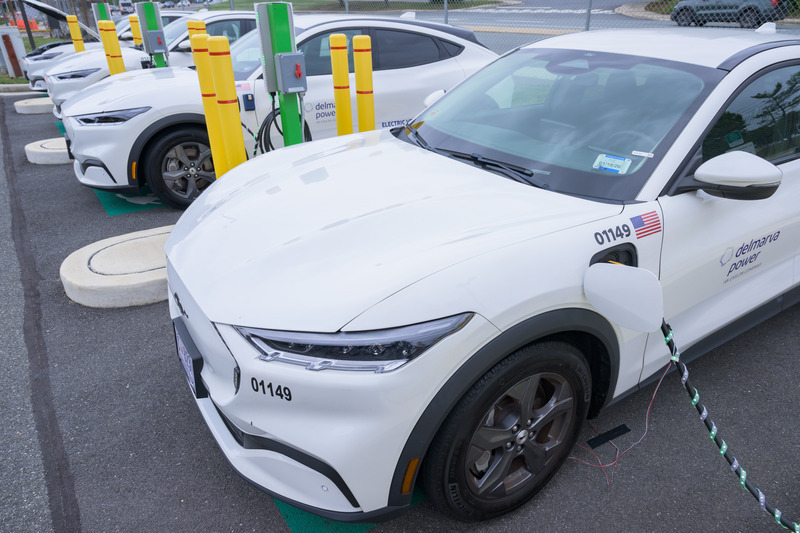
Earlier this year, UD researchers and colleagues at Delmarva Power/Exelon released a report validating that the UD-developed V2G technology is low-cost, high-value and scalable. The report showed electric vehicles equipped with V2G technology can be a moneymaker for private owners and businesses, earning roughly $3,300 for passenger vehicles and up to $9,000 for heavier vehicles, such as fleet vehicles or school buses.
<関連情報>
- https://www.udel.edu/udaily/2026/october/affordable-ev-technology-bidirectional-power-ud-innovation-willett-kempton/
- https://bpb-us-w2.wpmucdn.com/sites.udel.edu/dist/5/8632/files/2026/06/UD-Exelon-Report-V2G-Fleet-Operation-2026.pdf
車両フリート運用におけるV2Gグリッドサービスの機能と価値の評価 Evaluating the Capabilities and Value of V2G Grid Services in Fleet Operations
Willett Kempton, Garrett A. Ejzak, Safoura Faghri, Catherine M. Gilman, Maria Mediavilla Gallano, John G. Metz, Rafael B. S. Veras
Final report, 31 Mar 2026
Executive summary
The University of Delaware designed, and with Exelon and Delmarva Power, built and ran four V2G-capable EVs to provide grid services. These were tested operating both as individual EVs and aggregated into a virtual power plant (VPP). The project goal was not merely to demonstrate, but to test a matched set of new factors we believe will create a V2G industry that is low-cost, high revenue, and scalable. The project tested and evaluated new standards, interconnection requirements, and policies applied to existing EDC and RTO markets.
Engineering modifications to a standard production Ford Mach-E were designed by UD, with consultation from Ford Motor, to add bidirectional onboard chargers, three-phase charging connectors, and LIN-CP communications with extensive V2G controls and reporting. The UD design was then used by Autoport to retrofit four Delmarva Power fleet Mach-Es. Nuvve supplied four advanced AC charging stations and operated an aggregator capable of V2G control and reporting in either EDC or RTO markets. New standards tested include SAE J3068, LIN-CP, and SAE J3072, which together provide rich communications between the EV and EVSE and high-power AC charging.
PJM approved dispatch operations as a “pilot project,” so that they could test the capabilities of V2G running under PJM market rules complying with FERC Order 2222. The EVSEs were registered and interconnected for discharge and net metering by Delmarva Power, under existing state law and regulations. Six grid service markets were reviewed and two were implemented in the pilot, considering potential revenue, technical requirements, and near-term expected rules to enter and operate. Grid services are needed by the electric system to balance generation and load, adjust frequency and voltage, stand in readiness in case of unexpected failure, and to shift energy from times of surplus to times of shortage. Most or all of these services (depending on local rules) are markets that pay the provider for grid services. In this project, the EVs operated as providers in two grid service markets: PJM Regulation, and Arbitrage matched to a Delmarva Power time-of-use rate. For each market, the equipment standards, metering, interconnection and dispatch complied with the appropriate rules. Inoperation efficiency of the on-board bidirectional charge was calculated from meter readings to quantify energy losses during grid services. The EVs’ operational data was used to calculate the economic value in each market, including market revenue minus energy cost. EVs were run in each market during separate times; some value stacking would have been possible for these two markets but was not tested in this pilot project.
Under the rules of a PJM pilot project, we used a real but recorded dispatch signal, entered bids on the aggregator but did not send bids to PJM, and calculated value from utilitygrade power and energy meters, as no payment was made by PJM. For the PJM market, the aggregator treated all vehicles together as a “dispatch group” or VPP. Each EV continuously calculated its dynamic capacity to provide or absorb real power. Those limits were sent to the aggregator, which then tailored dispatch requests to each EV’s capability. Thus, the aggregator ensured that the set of EVs jointly met the PJM dispatch request and each EV produced or absorbed power within its capability. Analysis of the dispatch group showed that the combined group response to requests is extremely accurate and low latency, better by both metrics than current thermal generators in similar markets and well within PJM’s allowed tolerances. Unexpected events of single EVs have less effect on the dispatch group total, and progressively less as the group gets larger. During the one-year pilot project, EVs spent most of their time providing Regulation, yet using the OEM’s metric for battery health, no reduction in battery capability was measured over the one-year operational period.
For the TOU Arbitrage market in Delmarva Power, the EVs were again dispatched by Nuvve’s aggregator. TOU service was dispatched according to the tariff’s fixed clock times and preset kW rates, with the aggregator additionally constraining power to avoid extreme values and to prioritize trip needs. Since the TOU “market” is paid via reducing the utility customer’s bill, proportionally to performance, this market involves no bidding, no obligation to perform, and no payment by a 3rd party (such as PJM or an aggregator paying the asset owner). Due to this project’s design of interconnection and metering topology, switching from the wholesale PJM market to the retail EDC market, and back, was accomplished in a few minutes remotely, by the aggregation platform.
To calculate net revenue, the actual market rates were used for both markets; no subsidy or incentive payment was assumed. For Regulation, the 2021 through 2025 average market clearing prices were used. For TOU Arbitrage, the existing 2025 Delmarva Power TOU EV rate was used. The vehicles were assumed to be driving all work days but otherwise plugged in and performing grid services as they did in the pilot. We used local TOU rates for bill reduction, then separately calculated PJM Regulation value based on the range from the low to high years’ market prices ($21.15 to $54.97 MW-h). For a passenger vehicle (10 kW) TOU Arbitrage would earn $874/year, and PJM Regulation would earn from $1102 to $3359/year. For a heavier vehicle, using the now-standard 3-phase AC connector on the pilot vehicles (33 kW), TOU Arbitrage would earn $1043/year and PJM Regulation would earn $3195 – $9741/year. These figures are net of energy losses but do not include costs of customer support, aggregator fees or any allowance for battery wear. Beyond the markets tested, the PJM Capacity market may be comparable in value to PJM Regulation, but specific calculation awaits PJM’s definition qualifying DERs for Capacity under FERC Order 2222. Nevertheless, just the two markets tested yielded substantial revenue, suggesting several viable business models.
The value of mass-produced EVs providing these grid services is much more than the added cost to the EV and charging station equipment. This has two implications. First, when EVs are produced with this combination of equipment and policy allows their interconnection and participation, electric customers can reduce their electricity bills by providing grid services from their parked EVs. Second, EVs providing grid services will reduce the cost of running the electric system (because grid services will be lower cost and higher quality), which over time will reduce costs to all electric customers.
Multiple lessons learned are described in the final section, encompassing technology, interconnection process, market qualification, operations, and practice qualifying new standards for interconnection. This experience suggests several criteria for planning V2G implementation and/or trial customer offerings.
In summary, the design, components, policy and operations of this demonstration created a high-value virtual power plant, now proven in two markets. Production EVs and EVSEs using these designs and standards would yield V2G-capable fleets of lower cost and higher scalability than prior demonstration projects. A great deal was learned about implementation and operation. Thus, we believe that this project’s results provide guidance as to the expected capabilities and potential business models for practical modern V2G systems.