2026-11-02 中国科学院(CAS)
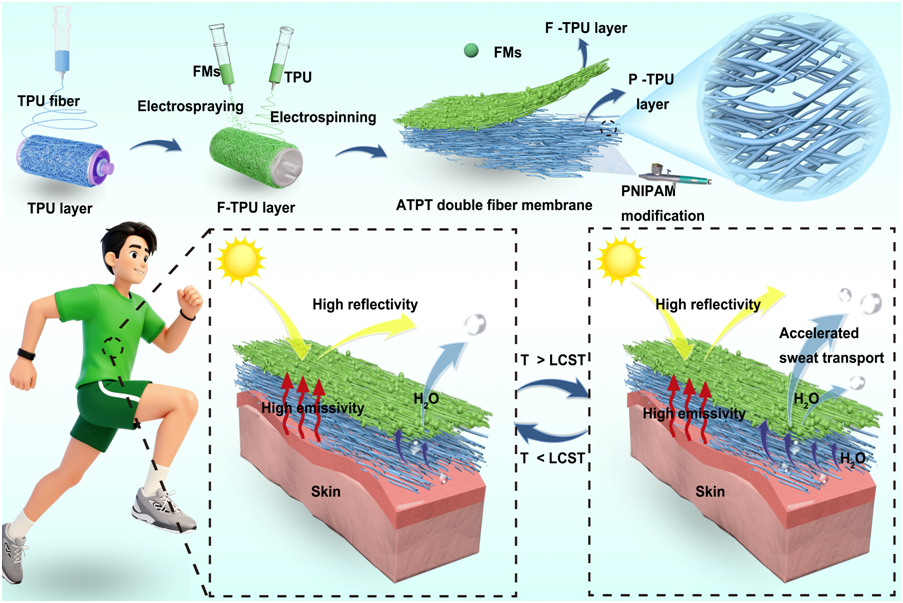
Schematic of the electrospun/electrosprayed FTPT membrane fabrication (top) and its self-adaptive thermal-wet regulation: high solar reflectance and infrared emission cool the skin, while the PNIPAM layer switches sweat transport below and above the LCST. (Image by Prof. WU’s group)
<関連情報>
- https://english.cas.cn/newsroom/research-news/202611/t20261102_1213007.shtml
- https://onlinelibrary.wiley.com/doi/10.1002/smll.76161
放射冷却のための蛍光競合吸収と自己適応型熱湿潤制御を備えた階層構造ナノファイバー膜 Hierarchical Nanofibrous Membranes With Fluorescent Competitive Absorption and Self-Adaptive Thermal-Wet Regulation for Radiative Cooling
Xuan Zhou, Haopeng Wang, Xianmei Huang, Haoran Zhai, Shuqiang Peng, Shuang Zhao, Tianyuan Li, Zixiang Weng, Lixin Wu
Small Published: 09 October 2026
DOI:https://doi.org/10.1002/smll.76161
Abstract
Passive daytime radiative cooling (PDRC) provides a zero-energy thermal management strategy. Thermoplastic polyurethane (TPU) is suitable for electrospun cooling textiles due to its spinnability, flexibility, and high infrared emissivity, but it suffers from UV-induced photothermal accumulation and aging. Here, we implement a nanoscale fluorescence-competitive absorption strategy by incorporating fluorescent microspheres (FMs) whose excitation spectrum fully covers the UV absorption band of TPU. These FMs convert UV photons into visible emission, simultaneously reducing photothermal conversion, enhancing UV stability, and enabling coloration. A highly reflective, hierarchical nanofibrous underlayer with a hierarchical fiber-diameter distribution, fabricated via high-concentration electrospinning, further achieves broadband scattering, thereby yielding an overall effective solar reflectance (ESRsol) of 96.7%. After 200 min of accelerated UV aging, the ESRsol decreases only slightly to 95.2%. The membrane exhibits a photoluminescence quantum yield of 63.3% and photon conversion efficiency of 53.2%. Meanwhile, integrated with a temperature-responsive dynamic moisture management structure, it reaches an evaporative cooling power of 392.4 W·m−2 at 38°C and 262.9 W·m−2 at 25°C. A Monte Carlo simulation validates the nano- and microscale structural design, offering a promising approach toward adaptive personal thermal management textiles.