2026-11-02 合肥物質科学研究院(HFIPS)
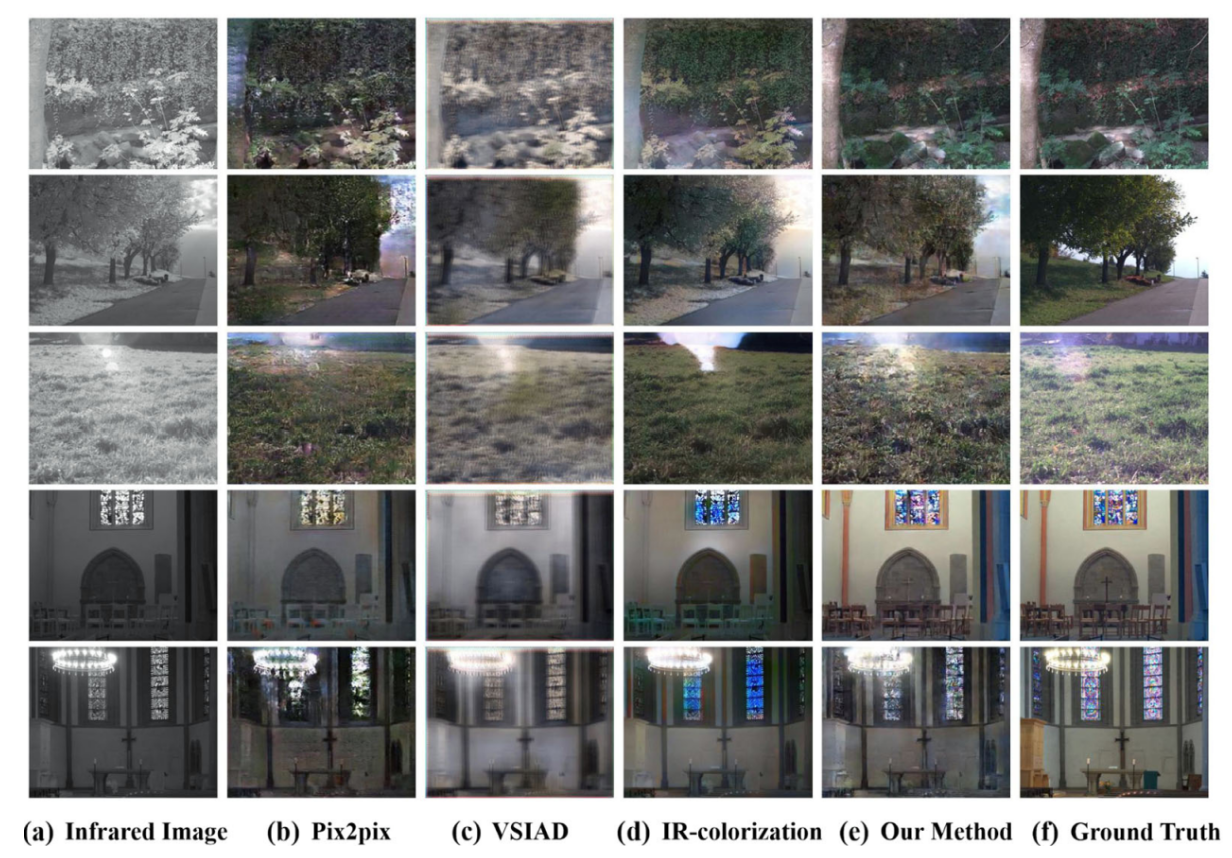
Near infrared image colorization and comparison of results across different methods. (Image by LIU Xiao)
<関連情報>
- https://english.hf.cas.cn/nr/rn/202611/t20261102_1213008.html
- https://opg.optica.org/ao/abstract.cfm?uri=ao-65-11-3798
Pix2Pixベースのカラー化のための3バンドSWIRイメージング Three-band SWIR imaging for Pix2Pix-based colorization
Qidong Chen, Xiao Liu, Lili Du, Bo Song, Xiaobing Sun, and Zhengyu Shen
Applied Optics Published: April 9, 2026
DOI:https://doi.org/10.1364/AO.590489
Abstract
The short-wave infrared imaging (SWIR) is indispensable in remote sensing due to its superior capability to penetrate atmospheric scattering and capture unique material reflectance signatures. However, SWIR imagery is typically acquired as single-channel grayscale data, suffering from a complete absence of chromatic information, which severely limits human interpretability and scene analysis. While deep learning-based methods have emerged to reconstruct visible colors from infrared inputs, they fundamentally struggle with mapping uncertainty arising from spectral ambiguity—where distinct materials manifest as identical grayscale intensities, rendering the inverse problem ill-posed. To resolve this bottleneck, we propose a physics-data dual-driven band selection framework integrated with a Pix2Pix network. The proposed framework consists of three stages: physical pre-selection based on atmospheric windows and material reflectance, statistical coarse-ranking utilizing a modified optimum index factor to minimize redundancy, and fine-grained task-driven generative evaluation. We identified a globally optimal three-band combination (1000–1050, 1050–1100, and 1525–1575 nm) that maximizes input discriminability, and employing a ResNet-based generator to filter radiometric noise, we effectively decouple mapping ambiguities. Experimental results demonstrate that this method significantly outperforms standard approaches. Specifically, our method improves the PSNR by 8.63%, the SSIM by 18.87%, and optimizes the perceptual metric LPIPS by 31.28% compared to the single-band U-Net baseline.