2026-02-18 カーディフ大学
<関連情報>
- https://www.cardiff.ac.uk/news/view/3024847-most-roadless-areas-in-great-britain-are-smaller-than-1km2
- https://www.nature.com/articles/s41598-026-36410-8
英国における野生動物と車両の衝突リスクの観点から、道路のない地域と分断の定量化 Quantifying roadless areas and fragmentation in the context of wildlife-vehicle collision risk in Great Britain
Sarah Raymond,Elizabeth A. Chadwick & Sarah E. Perkins
Scientific Reports Published:18 February 2026
DOI:https://doi.org/10.1038/s41598-026-36410-8
Abstract
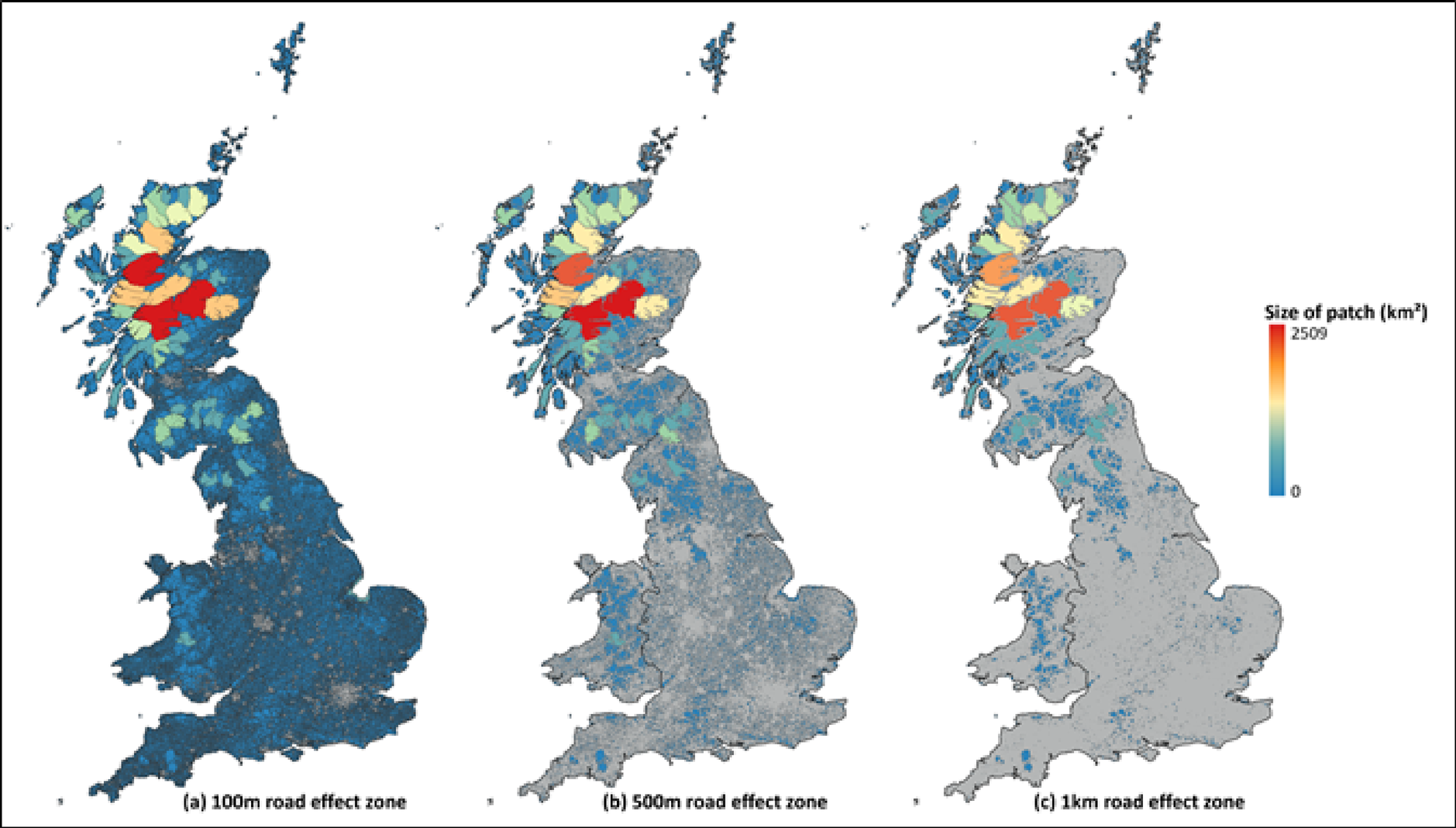
Roads cause indirect and direct effects for wildlife, including pollution, behavioural changes, wildlife mortality and habitat fragmentation. The ecological impacts of roads extend beyond their immediate vicinity, into ‘road effect zones’. Beyond road effect zones, ‘roadless areas’ can offer refuges from the ecological effects of roads. In this study, we quantify the number and distribution of roadless patches in Great Britain, their ecological status and their overlap with protected areas. Road effect zones applied 100, 500 and 1,000 m on either side of the road network revealed a highly fragmented landscape with 93,561, 29,164 and 6,138 roadless patches, covering 76.6%, 36.0% and 20.6% of terrestrial land, respectively. Roadless areas were smallest, on average, in England and largest in Scotland. For all road effect zones, more than 70% of patches were smaller than 1 km2. For the most commonly used road effect zone (1 km), more than 60% of roadless patches were smaller than the mean home range of common UK species, European badger Meles meles and red fox Vulpes vulpes, meaning they likely face a high risk of wildlife-vehicle collisions. Nearly half (47%) of roadless areas coincided with protected land and there was a weak but significant negative relationship between roadless patch size and ecological status. In conclusion, the landscape is fragmented into numerous, small roadless patches. We present roadless areas and their ecological features as an open access searchable map, constituting a tool for conservation practitioners and an important starting point for defragmentation campaigns.