2026-10-15 スウォンジー大学
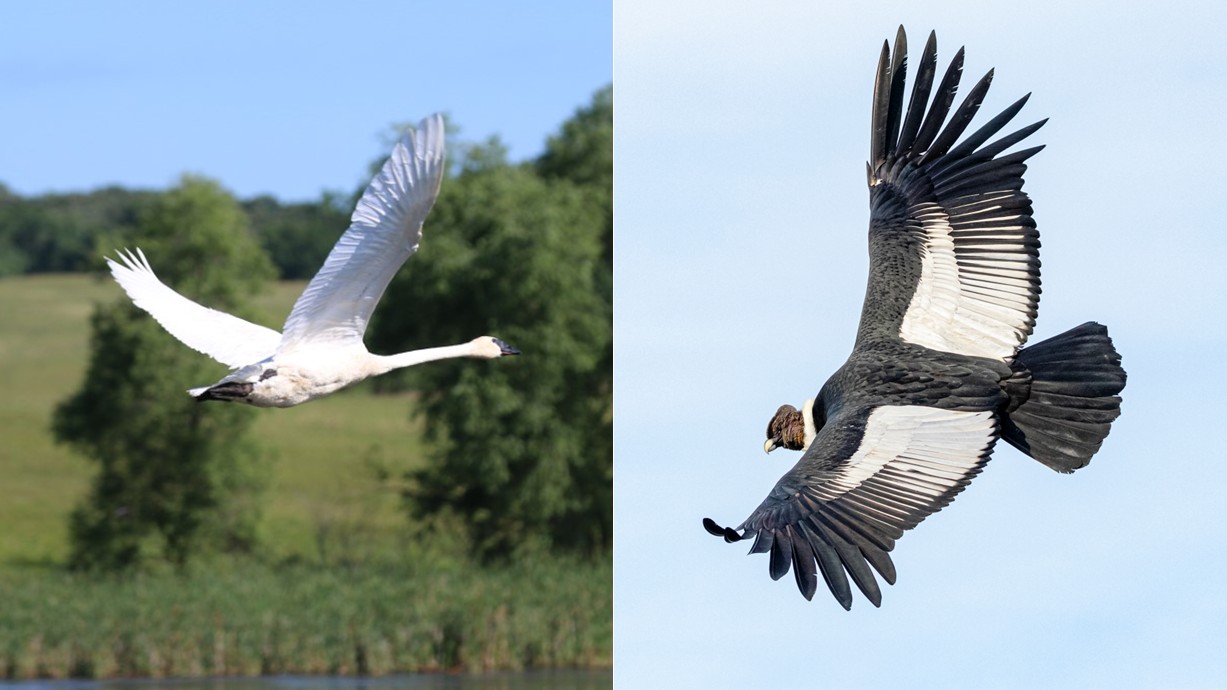
The trumpeter swan (left) and the Andean condor (right) are among the world’s heaviest flying birds. Despite their similar masses, the energy required to travel a given distance differs dramatically between the two species. Credit: Brett Blocker (Left) | Alvaro Moya Riffo (Right).
<関連情報>
- https://www.swansea.ac.uk/press-office/news-events/news/2026/10/wild-birds-rewrite-rules-for-travel–new-study-reveals-power-of-free-fuel-from-the-sky.php
- https://www.science.org/doi/10.1126/science.aee6550
気流が野生における航空輸送のコストを再定義する Airflows redefine the cost of aerial transport in the wild
Martina Scacco, Jeroen B. Smaers, Yuval Werber, Karen Aghababyan, […] , and Emily L. C. Shepard
Science Published:15 Oct 2026
DOI:https://doi.org/10.1126/science.aee6550
Abstract
Fuel economy matters to both animals and machines, as the cost of transport can determine where, when, and how far locomotion is possible. However, established estimates of these values for animal flight come from laboratories and treat the atmosphere as constant, even though free-flying animals routinely extract energy from atmospheric flows. Using high-resolution movement data, we estimate the cost of transport for 50 bird and bat species flying in the wild. Our results revise the classic ranking of locomotion costs, suggesting that flying can be cheaper than swimming though almost as costly as running, depending on interactions between physical environment, morphology, and behavior. Linking transport costs to atmospheric conditions provides a mechanistic basis for predicting how changing windscapes will reshape the energetics, movements, and distributions of flying animals.