2026-10-07 東京科学大学
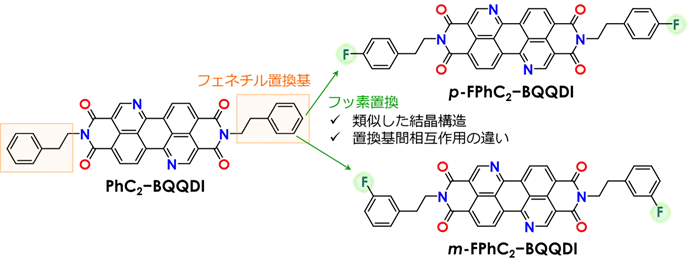
図1 PhC2-BQQDIと今回開発したフッ素置換体FPhC2-BQQDIの分子構造
<関連情報>
層状レンガ積み構造を持つn型有機半導体の結晶構造および電荷輸送特性に対するフルオロフェニル末端側鎖の影響 Impacts of fluorophenyl-terminal side chains on crystal structures and charge-transport properties of n-type organic semiconductors with layered brickwork packing motif
Shohei Kumagai, Takeru Koguma, Eiji Fukuzaki, Takuya Seki, Go Watanabe, Ryoya Kimura, Masafumi Yano, Hiroyuki Ishii, Jun Takeya & Toshihiro Okamoto
Scientific Reports Published:07 August 2026
DOI:https://doi.org/10.1038/s41598-026-35849-z
Abstract
Molecular packing is crucial for charge-transport properties of organic semiconductors (OSCs). Nowadays, most OSCs consist of the π-electron core and insulating side-chain substituents. While the former is the primary factor of molecular packing and resultant charge transport, the latter is also the significant tuning element for them. Hence, it is worth addressing their individual roles. In this work, a potential impact of fluorine substitution on molecular packing and charge-transport properties is reported based on the positional isomers of n-type OSCs which have phenethyl side chains: para-, meta– and ortho-substituted derivatives called p-FPhC2−BQQDI, m-FPhC2−BQQDI and o-FPhC2−BQQDI, respectively. Crystallographic analyses showed that the fluorine substitution position varies the intermolecular interactions through noncovalent C−H∙∙∙F interactions. Although resultant brickwork-type molecular packings suggested similar charge-transport capabilities, single-crystal thin-film transistor assessments revealed distinct differences in the electron mobility: 0.44, 0.92 and 3.56 cm2 V−1 s−1 for o-FPhC2−BQQDI, m-FPhC2−BQQDI and p-FPhC2−BQQDI, respectively. The difference between m-FPhC2−BQQDI and p-FPhC2−BQQDI is attributed to dynamic disorder effects based on molecular dynamics simulations, whereas the lowest mobility of o-FPhC2−BQQDI may further result from static, orientational disordering of the side chains revealed by X-ray crystallography. These findings will be useful for in-depth investigations of side-chain effects on charge-transport properties of OSCs.