2026-09-16 東京科学大学
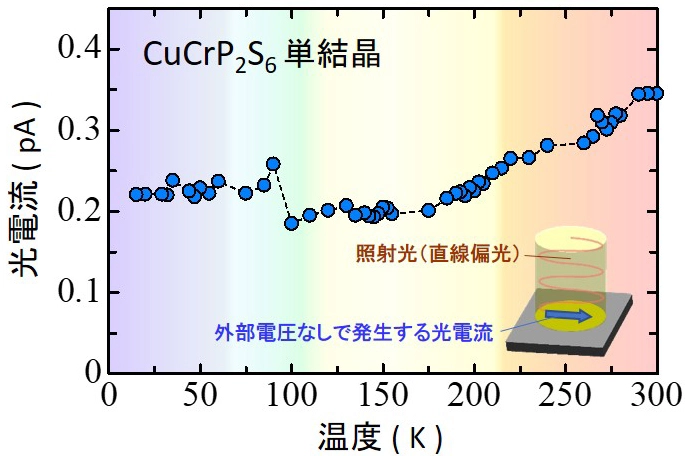
図1. CuCrP2S6単結晶に光照射し、外部電圧ゼロで発生する光電流の温度変化を測定した結果
<関連情報>
- https://www.isct.ac.jp/ja/news/5h55bf7sfuf7
- https://advanced.onlinelibrary.wiley.com/doi/10.1002/adfm.77517
CuCrP₂S₆ファンデルワールス結晶における中心対称相を超えた、異常な温度増強バルク光起電力効果 Unusual Temperature-Enhanced Bulk Photovoltaic Effect Beyond the Centrosymmetric Phase in CuCrP2S6 van der Waals Crystals
Ryoga Murata, Takao Sasagawa
Advanced Functional Materials Published: 09 August 2026
DOI:https://doi.org/10.1002/adfm.77517
ABSTRACT
The bulk photovoltaic effect (BPVE) enables photocurrent generation in non-centrosymmetric materials without p-n junctions. Among its mechanisms, the topological shift current is notable for its robustness against disorder and scattering. Here, we report an unconventional BPVE temperature evolution in single crystals of the van der Waals (vdW) multiferroic CuCrP2S6 (CCPS). A sizable in-plane zero-bias photocurrent emerges exclusively along the polar a-axis and shows electrode-independent behavior, together with light-power and wavelength dependencies consistent with a shift-current-type nonlinear optical response. Remarkably, this anisotropic BPVE persists across the phase transitions and is even enhanced toward room temperature, despite the time-averaged crystal structure becoming centrosymmetric (C2/c). Systematic measurements reveal that this temperature evolution is driven by dynamic lattice fluctuations within the Cu sublattice rather than static symmetry alone. Our findings demonstrate that instantaneous local symmetry breaking and nanoscale polar clusters can sustain and even enhance shift-current responses in a nominally centrosymmetric phase. This establishes a new materials paradigm for room-temperature BPVE, suggesting that dynamic disorder can be harnessed as a functional advantage in vdW-based optoelectronic devices.