2026-04-24 ミネソタ大学
<関連情報>
- https://cse.umn.edu/college/news/redesigning-metals-atomic-level-boost-future-technology
- https://www.nature.com/articles/s41467-026-69200-x
歪み安定化界面分極により、RuO₂/TiO₂ヘテロ構造における仕事関数が1 eV以上変化する Strain-stabilized interfacial polarization tunes work function over 1 eV in RuO2/TiO2 heterostructures
Seung Gyo Jeong,Bonnie Y. X. Lin,Mengru Jin,In Hyeok Choi,Seungjun Lee,Zhifei Yang,Sreejith Nair,Rashmi Choudhary,Juhi Parikh,Anand Santhosh,Matthew Neurock,Kelsey A. Stoerzinger,Jong Seok Lee,Tony Low,Qing Tu,James M. LeBeau & Bharat Jalan
Nature Communications Published:09 February 2026
DOI:https://doi.org/10.1038/s41467-026-69200-x
Abstract
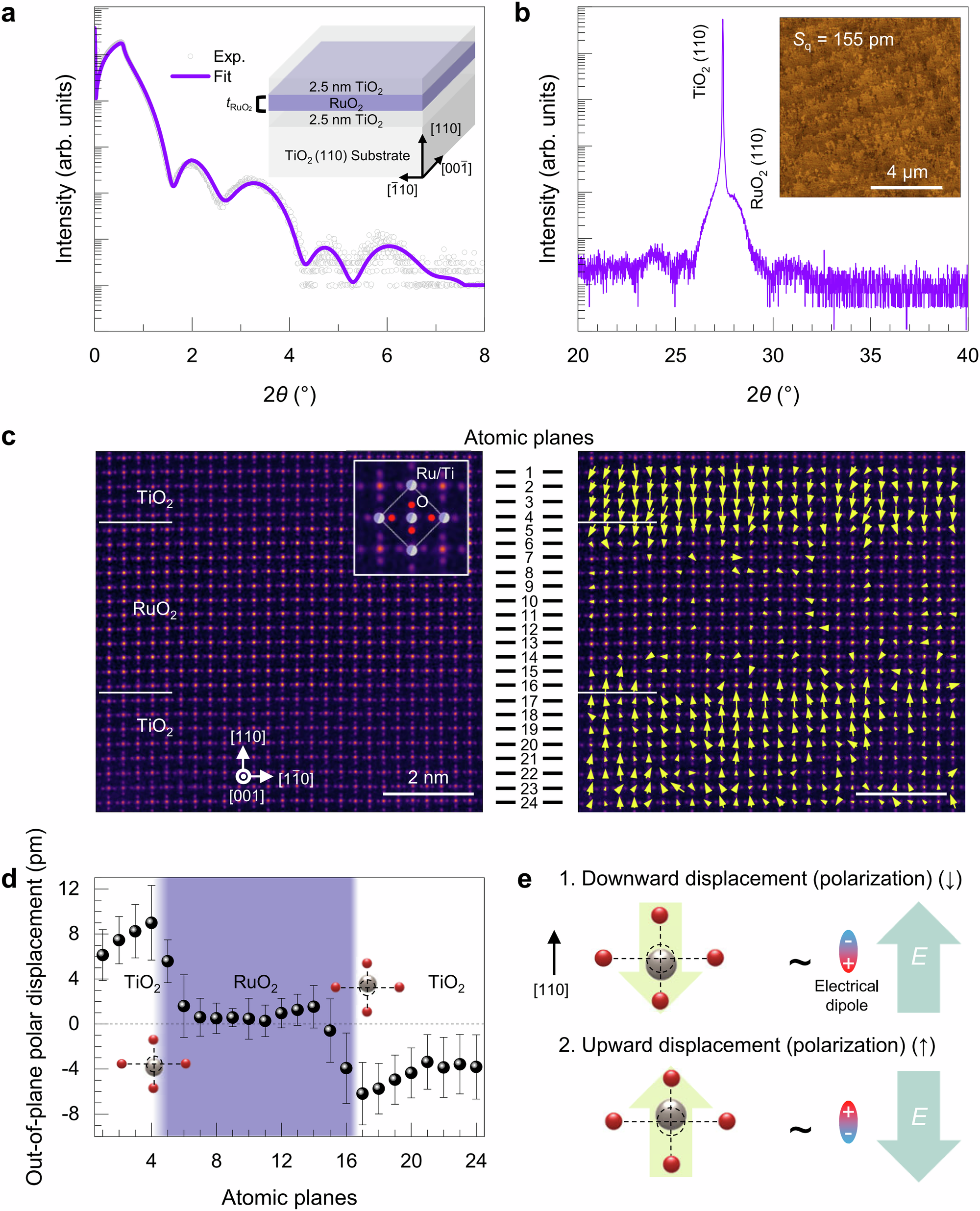
Interfacial polarization – charge accumulation at the heterointerface – is a well-established tool in semiconductors, but its influence in metals remains unexplored. Here, we demonstrate that interfacial polarization can robustly modulate surface work function in metallic rutile RuO2 layers in epitaxial RuO2/TiO2 heterostructures grown by hybrid molecular beam epitaxy. Using multislice electron ptychography, we directly visualize polar displacements of transition metal ions relative to oxygen octahedra near the interface, despite the conductive nature of RuO2. This interfacial polarization enables over 1 eV modulation of the RuO2 work function, controlled by small thickness variations (2-3 nm), as measured by Kelvin probe force microscopy, with a critical thickness of ~4 nm – corresponding to the transition from fully-strained to relaxed film. These results establish interfacial polarization as a powerful route to control electronic properties in metals and have implications for designing tunable electronic, catalytic, and quantum devices through interfacial control in polar metallic systems.