2026-04-30 中山大学(SYSU)
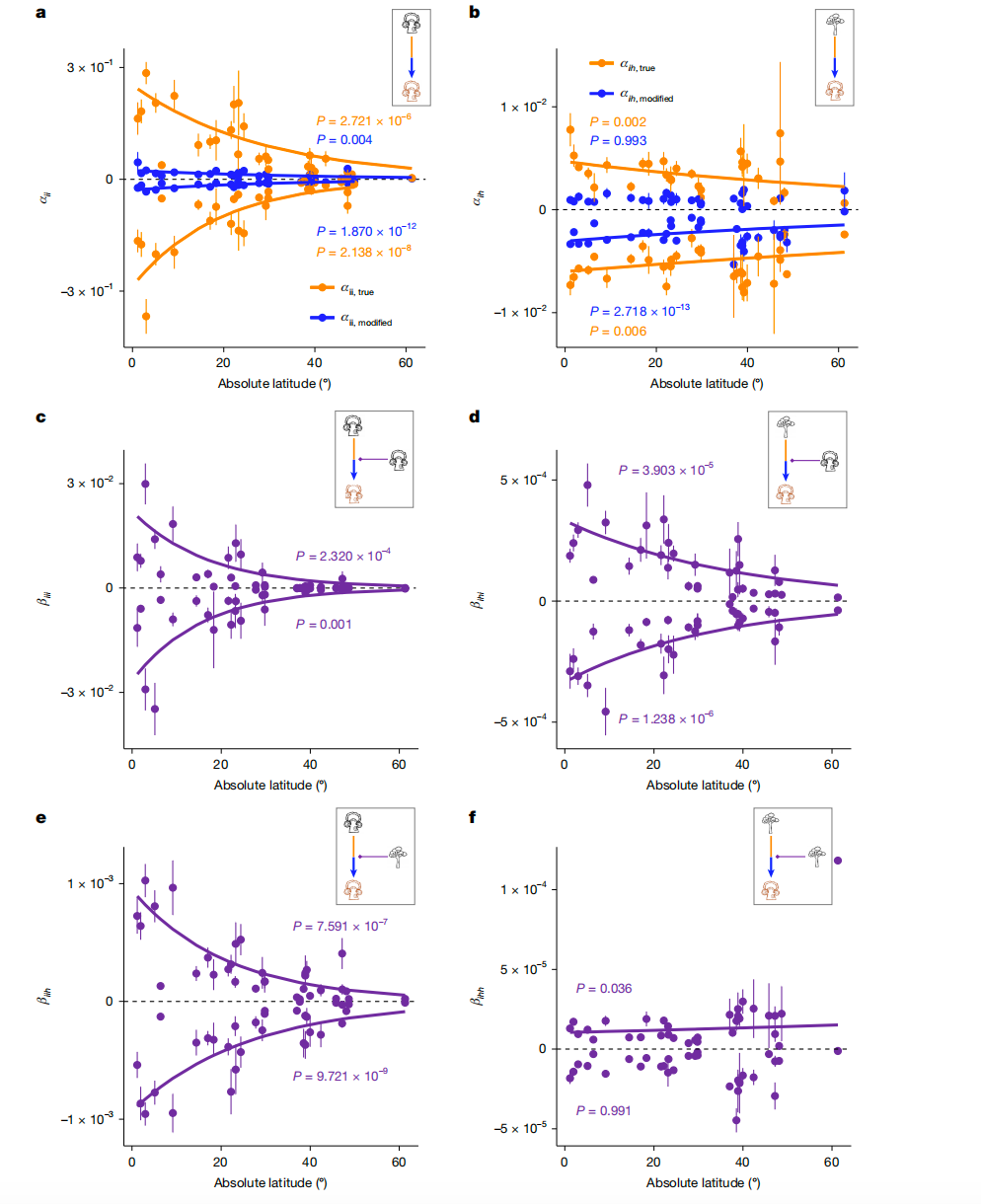
Latitudinal changes in pairwise and HOIs for growth models.
<関連情報>
- https://www.sysu.edu.cn/sysuen/info/1012/59141.htm
- https://www.nature.com/articles/s41586-026-10434-6
高次相互作用は緯度方向の樹木多様性勾配を増強する Higher-order interactions enhance the latitudinal tree diversity gradient
Yuanzhi Li (李远智),Junli Xiao (肖俊丽),Yuan Jiang (江园),Stuart Joseph Wright,Margaret M. Mayfield,Oscar Godoy,Alfonso Alonso,Kristina J. Anderson-Teixeira,Jennifer Baltzer,Joseph D. Birch,Pulchérie Bissiengou,Norman A. Bourg,Warren Brockelman,David F. R. P. Burslem,Min Cao (曹敏),Keith Clay,Stuart J. Davies,Qingqing Du (杜晴晴),Sisira Ediriweera,Anna Feistner,Edwino S. Fernando,Gregory S. Gilbert,Zhanqing Hao (郝占庆),Jan Holík,… Chengjin Chu (储诚进)
Nature Published:29 April 2026
DOI:https://doi.org/10.1038/s41586-026-10434-6
Abstract
The global decrease in species diversity from low to high latitudes is among the most robust biogeographic patterns1,2. There is continuing debate on the contribution of conspecific negative density dependence (CNDD) to the latitudinal diversity gradient evident for trees3,4. Theory suggests that CNDD based on pairwise interactions alone is not sufficient to explain the intricacies of diverse communities, because higher-order interactions (HOIs) may greatly modify these interactions5,6. However, there has been a lack of empirical studies investigating how HOIs intertwine with pairwise interactions and how they may contribute to the latitudinal tree diversity gradient. Here we examined both pairwise interactions and HOIs across 32 large permanent forest plots, most in the northern hemisphere. We detected evidence of HOIs in 40% of the 1,543 species–plot combinations for tree growth, and 23% of the 1,340 such combinations for tree survival, with the strength of these interactions declining with latitude. HOIs were found to benefit rare species but disadvantage common species, suggesting a potential mechanism promoting species diversity. This stabilizing effect weakened towards higher latitudes, consistent with the latitudinal tree diversity gradient. Our findings reveal an important interplay between pairwise interactions and HOIs in promoting the latitudinal tree diversity gradient and help to clarify the contribution of CNDD to this biogeographic pattern.