2026-04-27 中国科学院(CAS)
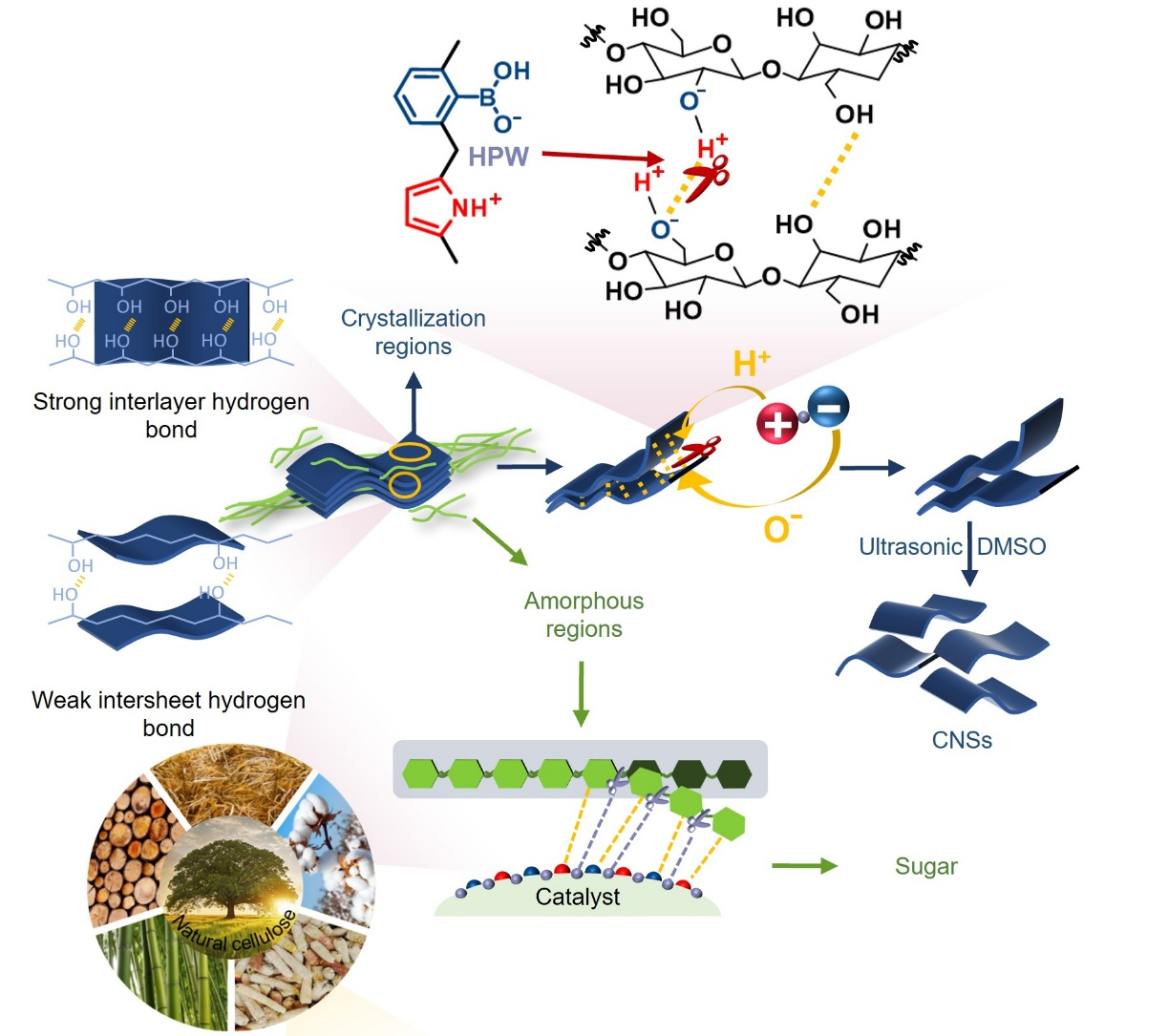
The selective hydrolysis of natural cellulose to acquire 2D CNSs (Image by NIMTE)
<関連情報>
- https://english.cas.cn/newsroom/research-news/202604/t20260428_1158213.shtml
- https://onlinelibrary.wiley.com/doi/10.1002/sus2.70064
天然セルロースからの2次元セルロースナノシートの抽出 Extraction of 2D Cellulose Nanosheets From Natural Cellulose
Jinhang Yang, Chengqi Feng, Chenkai Jin, Yan Lei, Haining Na, Jin Zhu
SusMat Published: 25 March 202
DOI:https://doi.org/10.1002/sus2.70064
ABSTRACT
Cellulose is a non-food biomass with a hierarchical chemical structure, yet suitable and general methods for the selective acquisition of its 2D structure are still lacking. In this study, 2D cellulose nanosheets (CNSs) are directly extracted from cellulose using zwitterion combined with phosphotungstic acid (HPW) as the catalyst. The size of the CNSs is in the range of 1–20 µm with a thickness of 15–28 nm. Each CNS is composed of a number of cellulose nanocrystals with lengths of 150–400 nm and diameters of 5–28 nm. The discovery of CNSs confirms the inherent 2D structures aggregated at the sub-micro level. This provides an updated view of the hierarchical structure of natural cellulose, which is composed of nanosheets, nanocrystals, and elementary fibrils. This method enables the selective extraction of CNSs under mild conditions, featuring high selectivity and broad generality. As a new type of 2D nanomaterials, the average modulus, roughness, and adhesion force of single layer CNSs are 7.2 GPa, 0.5 nm, and 7.49 nN. CNSs may open new avenues for applications in barrier materials, energy storage, catalyst carriers, composites, and selective adsorption.