
2026-04-15 熊本大学
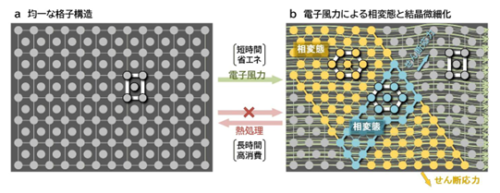
図1 高密度パルス電流による「電子風力(非熱的効果)」が原子を動かし、短時間で相変態と組織微細化を誘起する模式図(従来の熱処理との比較)
<関連情報>
- https://www.kumamoto-u.ac.jp/whatsnew/sizen/260415
- https://www.kumamoto-u.ac.jp/daigakujouhou/kouhou/pressrelease/wgt3jw/release260415.pdf
- https://www.nature.com/articles/s41467-026-70561-6
二相チタン合金における電流駆動による不均一な微細構造 Electric current-driven heterogeneous microstructures in dual-phase titanium alloys
Shaojie Gu,Yasuhiro Kimura,Yi Cui,Yasuyuki Morita,Sora Isoi,Chang Liu,Xinming Yan,Bingfeng Ju,Huayong Yang,Yuhki Toku & Yang Ju
Nature Communications Published:13 April 2026
DOI:https://doi.org/10.1038/s41467-026-70561-6
Abstract
Heterostructures are a powerful strategy for overcoming the long-standing strength–ductility trade-off in structural materials. However, conventional routes to such architectures often rely on complex thermomechanical treatments, limiting scalability and energy efficiency. Here, we report a hierarchical multiphase heterogeneous microstructure in dual-phase titanium alloys, achieved through a single-step high-density pulsed electric current treatment. The resulting architecture comprises 5–6 phases or components across multi-scale from 1 nm to 10 µm, and exhibits a breakthrough in the strength–ductility trade-off, achieving 13.5% and 12.1% higher strength and 13.1% and 14.5% greater ductility for Ti-6Al-4V and Ti-6Al-7Nb, respectively. In-situ transmission electron microscopy and pre-micromachined structure analysis reveal a previously unreported phase transition mechanism: electron wind-driven precipitation of nanoscale α′ martensite within β phases via limited atomic diffusion, accompanied by localized chemical ordering. This work introduces a rapid and energy-efficient processing method, where the entire treatment is completed within milliseconds and the total energy consumption is reduced by more than 50% compared to conventional processing methods. The proposed approach offers a promising route for designing and modifying metallic heterostructures, holding significant implications for next-generation structural materials.
