2026-05-01 東北大学
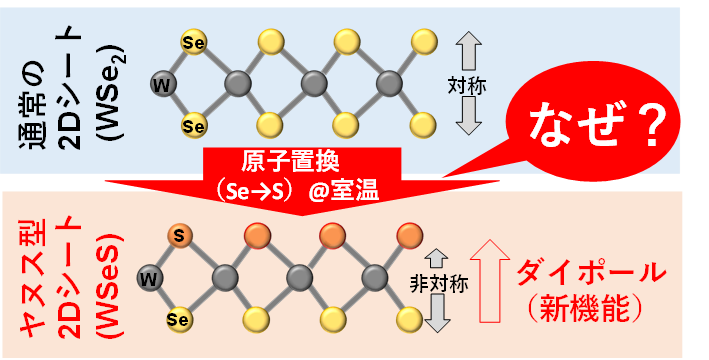
図1. 本研究の全体概要図(通常の2Dシートとヤヌス型2Dシートの比較)
<関連情報>
- https://www.tohoku.ac.jp/japanese/2026/05/press20260501-01web-janus2d.html
- https://pubs.acs.org/doi/10.1021/acsmaterialslett.6c00018
ヤヌス型2次元半導体における室温トポタクティック置換を促進する電子蓄積の隠れた役割 Hidden Role of Electron Accumulation in Driving Room-Temperature Topotactic Substitution for Janus 2D Semiconductors
Dingkun Bi,Tianyishan Sun,Weizi Lu,Hiroto Ogura,Yanlin Gao,Mina Maruyama,Susumu Okada,and Toshiaki Kato
ACS Materials Letters Published: April 20, 2026
DOI:https://doi.org/10.1021/acsmaterialslett.6c00018
Abstract
Understanding atomic substitution in Janus transition metal dichalcogenides (TMDs) is crucial for controlling intrinsic out-of-plane dipoles and electronic asymmetry. Although room-temperature Janus conversion has been reported, the microscopic origin of selective chalcogen replacement remains unclear. Here, we develop an in situ optical–electrical platform enabling correlated Raman and field-effect transistor measurements during plasma-assisted atomic-layer substitution under vacuum. We identify a plasma-electron-assisted room-temperature topotactic reaction, in which electrons accumulate near the TMD surface and at the MoSe2/SiO2 interface, weaken metal–chalcogen bonds, and facilitate hydrogen-assisted substitution. Density functional theory calculations show that excess electron doping lowers bond formation energies. Ultraviolet illumination further enhances electron accumulation and accelerates substitution kinetics. This work experimentally verifies a charge-mediated topotactic substitution mechanism and establishes plasma-electron-assisted synthesis as a route for room-temperature Janus TMD formation.