2026-04-30 防災科学技術研究所
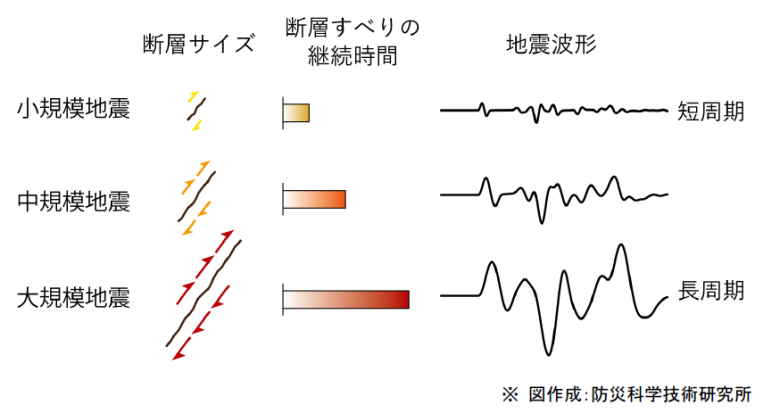
図1 地震の自己相似則
一般に、小さな地震は小さな断層を短時間で破壊し、周期の短い地震波を放射する。一方で、大きな地震は大きな断層を長時間かけて破壊し、周期の長い地震波を放射する。このように、地震の規模と断層破壊が終了するまでの時間との間には一定の関係(Tw 〜 Mo⅓ )があり、地震の自己相似則と呼ばれている。
<関連情報>
- https://www.bosai.go.jp/sp/info/press/2026/20260430.html
- https://www.nature.com/articles/s41467-026-72217-x
制御された断層アスペリティによって解明される非自己相似地震のダイナミクス Dynamics of non-self-similar earthquakes illuminated by a controlled fault asperity
Kurama Okubo,Futoshi Yamashita & Eiichi Fukuyama
Nature Communications Published:30 April 2026
DOI:https://doi.org/10.1038/s41467-026-72217-x
Abstract
Most ordinary earthquakes follow self-similar scaling, where source duration scales with the cube root of seismic moment. However, some earthquake clusters show non-self-similar scaling, in which source duration remains nearly constant regardless of seismic moment. Their source mechanisms, previously proposed to involve fixed source dimensions with variable stress drop or accelerating rupture velocity, are not fully validated due to uncertainties in estimating source properties, often caused by observational biases such as path effects. Here, we present a dynamic rupture model for non-self-similar earthquakes based on laboratory experiments conducted on a meter-scale fault with size- and shape-controlled gouge patch sources. By carefully applying corrections for instrumental response, sensor coupling, and attenuation to acoustic emission waveforms, we reliably constrain the source parameters of gouge patch events and identify non-self-similar scaling across magnitudes from Mw -7.3 to -6.0. We further develop a dynamic rupture model that quantitatively explains the observed source parameters by incorporating a fixed source-patch size, variable stress drop within the patch, and self-healing friction. This modeling framework complements previously proposed models and expands the range of tectonic conditions under which non-self-similar earthquakes may occur.