2026-04-23 東北大学
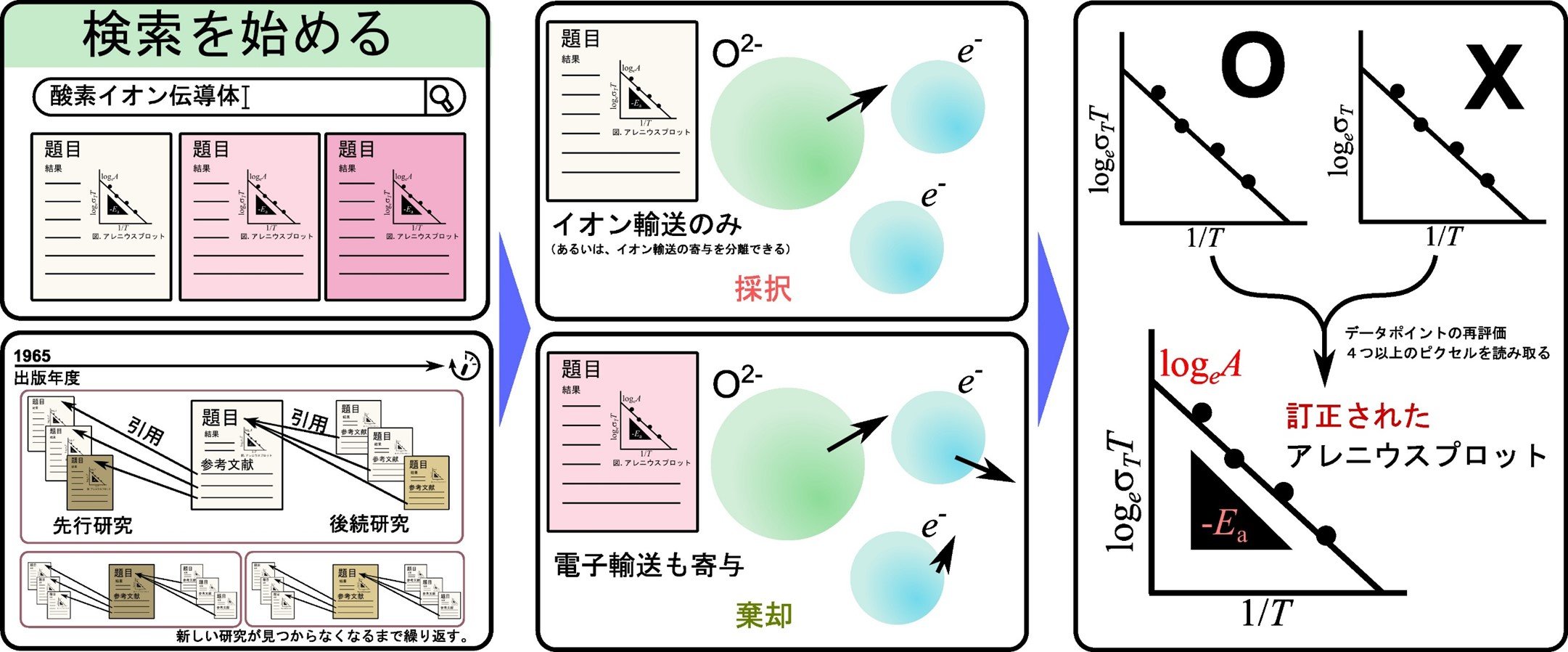
図1. 本研究におけるデータセット構築・キュレーションの流れ。文献探索、対象データの選別、アレニウスプロットの再評価という一連の手順を示しています。特に、誤った式の使用に起因する系統誤差を補正するため、元論文の図表からデータ点を再抽出し、活性化エネルギーと前因子を統一的に再計算した点が本研究の重要な特徴です。
<関連情報>
- https://www.tohoku.ac.jp/japanese/2026/04/press20260423-03-ion.html
- https://www.tohoku.ac.jp/japanese/newimg/pressimg/tohokuuniv-press20260423_03web_ion.pdf
- https://www.nature.com/articles/s41597-026-07100-x
酸素イオン伝導体の現状把握:解釈可能な回帰モデルを用いた60年間のデータセット Charting the Landscape of Oxygen Ion Conductors: A 60-Year Dataset with Interpretable Regression Models
Seong-Hoon Jang,Shin Kiyohara,Hitoshi Takamura & Yu Kumagai
Scientific Data Published:01 April 2026
DOI:https://doi.org/10.1038/s41597-026-07100-x Unedited version
Abstract
Oxygen ion conductors are indispensable materials for such as solid oxide fuel cells, sensors, and membranes. Despite extensive research across diverse structural families, systematic data enabling comparative analysis remains scarce. Here, we present a curated dataset of oxygen ion conductors compiled from 84 experimental reports spanning 60 years, covering 483 materials. Each record includes activation energy (Ea) and prefactor (A) derived from Arrhenius plots, alongside detailed metadata on structure, composition, measurement method, and data source. When the original papers derive these using an erroneous Arrhenius equation, we replotted these using the correct one. To illustrate how the database can be used, we constructed interpretable regression models for predicting oxygen ionic conductivity. Two symbolic regression models for Ea and A suggest that oxygen ion transport is primarily governed by local coordination environment and the electrostatic interactions, respectively. This dataset establishes a reliable foundation for data-driven discovery and predictive modeling of next-generation oxygen ion conductors.