2026-04-27 産業技術総合研究所
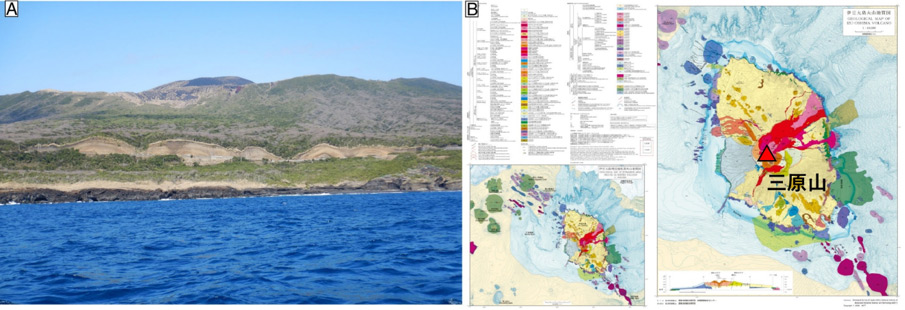
A 観測中に伊豆大島南岸沖合から見た地層大切断面と三原山。B 「伊豆大島火山地質図(第2版)」。地名を加筆。
<関連情報>
- https://www.aist.go.jp/aist_j/press_release/pr2026/pr20260427_2/pr20260427_2.html
- https://www.sciencedirect.com/science/article/abs/pii/S0012821X1500518X
- https://www.sciencedirect.com/science/article/abs/pii/S0377027314002467
伊豆大島火山のマグマ混合マグマの漸進的な再充填:マグマ溜まりの体積に関するガイド Progressive mixed-magma recharging of Izu-Oshima volcano, Japan: A guide to magma chamber volume
Osamu Ishizuka, Rex N. Taylor, Nobuo Geshi, Teruki Oikawa, Yoshihisa Kawanabe, Itaru Ogitsu
Earth and Planetary Science Letters Available online: 24 August 2015
DOI:https://doi.org/10.1016/j.epsl.2015.08.004
Highlights
- Izu-Oshima volcano of Izu-Bonin arc shows systematic temporal geochemical variation.
- Evidence of interaction between frontal arc and reararc magmas was obtained.
- Temporal geochemical variation provides constraints on magma supply and its storage.
Abstract
To discover how magmas move and interact beneath an arc we have examined the temporal and spatial evolution of the largest Izu-Bonin frontal arc volcano Izu-Oshima and the adjacent Izu-Tobu field of backarc volcanoes. Extensive 14C ages and geochemical analysis of subaerial satellite cones as well as other effusives has enabled us to construct a well-constrained ~14ka record of Izu-Oshima volcanism.
The geochemistry of Izu-Oshima is found to change systematically through the last 14 000 yr. Ba/La, Pb/Ce, 87Sr/86Sr, 143Nd/144Nd and 206Pb/204Pb all decrease between 10 ka and 5 ka before increasing between 5 ka and the present, while La/Yb and Nb/Zr show the reverse. These changes in composition match the addition of Izu-Tobu (backarc) magma to the Izu-Oshima plumbing system with a maximum of a 40% Izu-Tobu at around 5 ka. Progressive but asymptotically declining changes in composition through the 10–5 ka period are found to fit a model where pre-mixed magma is episodically added to, and mixed with, a chamber beneath Izu-Oshima. The 5–0 ka period reverses this trend, but is again progressive and declining, suggesting a switch to a progressive influx of pure Izu-Oshima frontal arc magma. Combining flux and eruption volume estimates with the observed geochemical mixing rates indicates that the accessible melt volume of the Izu-Oshima magma system is ~16km3 . Interaction and pre-mixing between the fluid-dominated frontal arc melt and the sediment-bearing backarc magmas must occur at deeper levels within the arc crust. This deep reservoir receives a continuous feed from the frontal arc mantle, but may periodically intercept rising magmas from the backarc source to produce episodes of magma mixing on timescales of ~5000yr.
This study demonstrates that interaction between frontal arc and backarc magma needs to be considered to achieve better understanding of material transfers and elemental budgets at subduction zones.
伊豆大島火山沖合の海底噴火割れ目から推測される弧状火山からの長距離マグマ輸送(伊豆・小笠原弧) Long-distance magma transport from arc volcanoes inferred from the submarine eruptive fissures offshore Izu-Oshima volcano, Izu–Bonin arc
Osamu Ishizuka, Nobuo Geshi, Yoshihisa Kawanabe, Itaru Ogitsu, Rex N. Taylor, Taqumi Tuzino, Izumi Sakamoto, Kohsaku Arai, Shun Nakano
Journal of Volcanology and Geothermal Research Available online: 17 August 2014
DOI:https://doi.org/10.1016/j.jvolgeores.2014.08.006
Highlights
- Izu-Oshima volcano is flanked by submarine ridges extending up to 22 km.
- Submersible survey revealed that submarine ridges are eruption fissures.
- Subaerial cones and submarine ridges represent the locus of magma transport events.
- Izu-Oshima provides concrete evidence of long-distance lateral magma transport.
- Long-distance magma transport is developed in a regional extensional regime.
Abstract
Long-distance lateral magma transport away from volcanic centers in island arcs is emerging as a common phenomenon where the regional stress regime is favorable. It should also be recognized as an important factor in the construction and growth of island arcs, and a potential trigger for devastating eruptions. In this contribution, we report on recent investigations into the magma dynamics of Izu-Oshima volcano, an active basaltic volcano with an extensive fissure system.
Izu-Oshima is flanked by numerous, subparallel NW–SE trending submarine ridges extending up to 22 km to the NW and the SE from the central vent. During a recent submersible survey we have identified that these ridges are fissures which erupted basaltic spatter and lava flows. Furthermore, lavas are petrographically similar along each ridge, while there are noticeable differences between ridges. The subparallel ridges are observed to transect a series of seamounts – the Izu-Tobu monogenetic volcanoes – which are dispersed across this area of the rear-arc. However, there are consistent petrographic and chemical differences between these seamounts and the ridges, indicating that they have different magma sources, yet, they are essentially bounding each other in dive tracks. The most appropriate scenario for their development is one where the Izu-Tobu Volcanoes are fed by an “in-situ” underlying source, while the NW–SE ridges are fed by lateral magma transport from Izu-Oshima.
Magma erupted from each ridge is of a consistent geochemistry along its length, but has experienced crystal fractionation and some plagioclase accumulation. Compositions of the ridges are also very similar to lavas from the subaerial cones that can be traced down the flanks of Izu-Oshima. This implies that pairs of subaerial cones and submarine ridges represent the locus of magma transport events away from the storage system beneath Izu-Oshima. Hence, magma from this crustal reservoir moved upward to feed the on-edifice cones, as well as laterally to supply submarine fissures and dykes to a distance of 22 km.