2026-10-10 中国科学院(CAS)
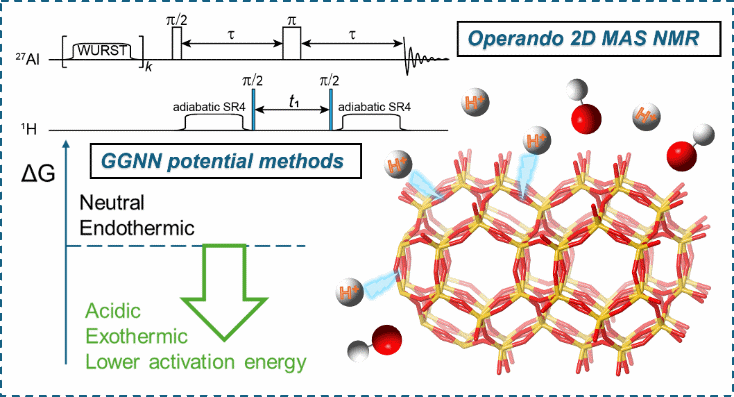
Proton-mediated host–guest interactions during molecular sieve crystallization revealed by ultrafast operando 2D solid-state NMR and GGNN potential methods. (Image by WU Daoning)
<関連情報>
- https://english.cas.cn/newsroom/research-news/202610/t20261010_1202224.shtml
- https://pubs.acs.org/jacsat/article-abstract/doi/10.1021/jacs.6c12306/5441789/Proton-Mediated-Host-Guest-Interactions-Direct?redirectedFrom=fulltext
プロトンを介したホスト-ゲスト相互作用が分子ふるい結晶化における核形成と形態変化を制御する Proton-Mediated Host–Guest Interactions Direct Nucleation and Morphology Evolution in Molecular Sieve Crystallization
Daoning Wu;Sicong Ma;Lixin Liang;Yury G. Kolyagin;Yankai Bian;Tongyao Wang;Quanzheng Deng;Lu Han;Olivier Lafon;Jean-Paul Amoureux;Guangjin Hou;Weili Dai
Journal of the American Chemical Society Published:September 29, 2026
DOI:https://doi.org/10.1021/jacs.6c12306
Abstract
The crystallization of aluminophosphate (AlPO4–n) and silicoaluminophosphate (SAPO-n) molecular sieves under acidic conditions represents a significant mechanistic departure from well-established alkaline routes for zeolites. Here, we elucidate how protons actively gate the nucleation and growth of AlPO4–n /SAPO-n frameworks. By integrating ultrafast operando two-dimensional (2D) solid-state NMR (acquiring high-quality 1H–27Al HMQC spectra in just 30 seconds) with density functional theory (DFT) simulations, we resolve a proton-mediated dual-channel gating mechanism: under acidic conditions, protons lower the kinetic barrier for P–O–Al condensation from 0.63 to 0.25 eV while simultaneously increasing the thermodynamic driving force for framework assembly, thereby markedly accelerating nucleation. Operando NMR further reveals an alternating dominance between water/hydroxyl-driven hydrolysis and OSDA-driven templating, a dynamic gating that directs the conversion of amorphous precursors into ordered nuclei via a reversibly formed interfacial intermediate. Moreover, the protonation effect enables selective facet stabilization by acetate species, steering crystal morphology from cubic to nanoscale sheet-like or rod-like architectures across diverse topologies (AFI, CHA, AEI). Our findings redefine acidity from a passive reaction medium into an active director of zeolite crystallization pathways, establishing it as a designable parameter in nucleation theory and providing a rational basis for engineering molecular sieves with controlled morphologies and framework topologies.