
2026-10-29 東京科学大学
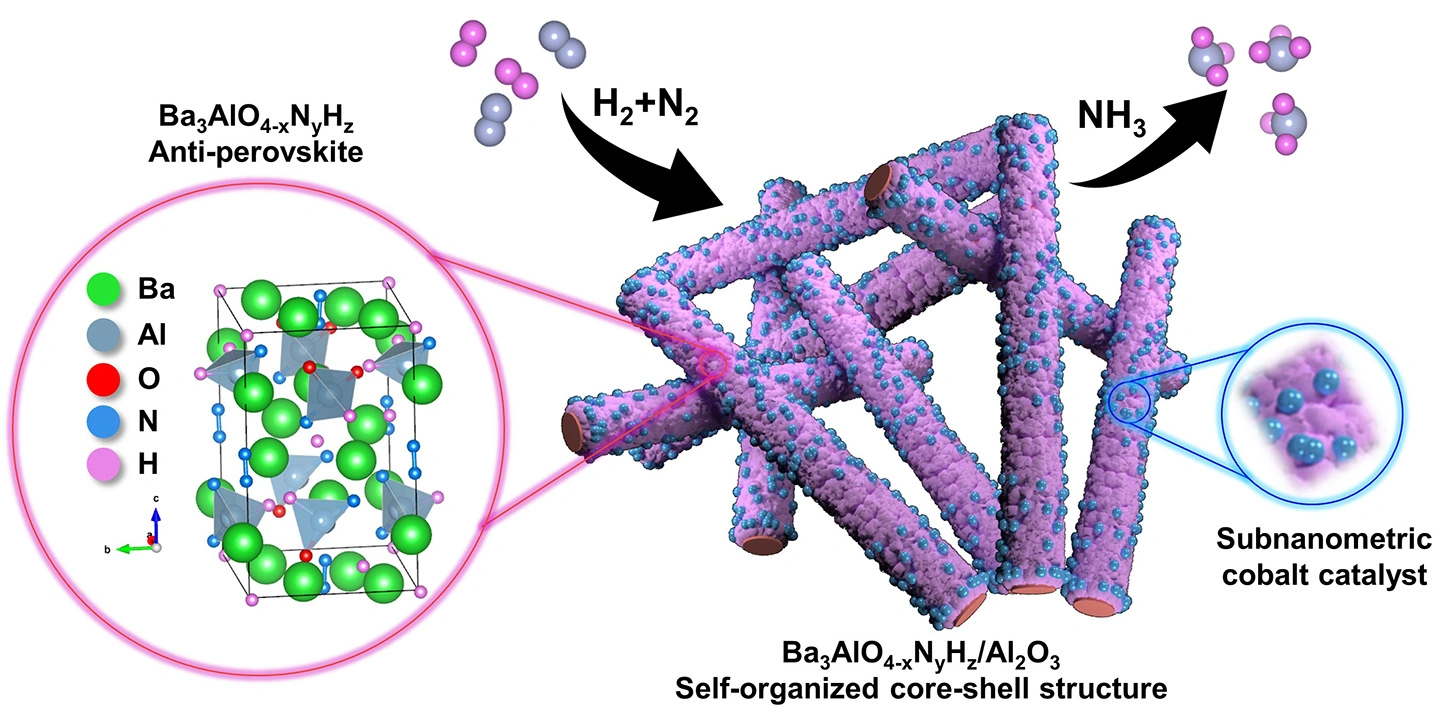
本研究の概要図
<関連情報>
- https://www.isct.ac.jp/ja/news/eblvmd5h0dx2
- https://pubs.acs.org/jacsat/article/doi/10.1021/jacs.6c06380/5459528/Hierarchically-Structured-Anti-Perovskite
階層構造を有するアンチペロブスカイト型オキシナイトライド-ハイドリドによる、(N2) −イオン を介した協同機構によるアンモニア合成 Hierarchically Structured Anti-Perovskite Oxynitride-Hydride Enabling Ammonia Synthesis via a Cooperative Mechanism Mediated by (N2)− Ions
Yihao Jiang; Chenyang Zhu; Jiang Li; Shun Sato; Masato Sasase; Shinya Masuda; Hideo Hosono; Masaaki Kitano
Journal of the American Chemical Society Published: October 28, 2026
DOI:https://doi.org/10.1021/jacs.6c06380
Abstract
Ba3AlO4-xNyHz with an antiperovskite structure is employed as a support for transition-metal catalysts for ammonia synthesis. This metastable material is synthesized by employing multiple anions with different valences and ionic radii. The optimized non-noble metal catalyst, Co(5.8 wt %)/Ba3AlO4-xNyHz/Al2O3, exhibits an exceptional ammonia synthesis rate of 15.9 mmol g–1 h–1 at 0.9 MPa and 300 °C, outperforming benchmark Cs–Ru/MgO, industrial Fe catalyst, and recently reported non-noble metal catalysts. Structural analyses show that Ba3AlO4-xNyHz and Co species self-organize on γ-Al2O3 nanorods to form a hierarchically structured catalyst. Combined experimental and density functional theory analyses reveal that the high activity originates from incorporated (N2)− ions at Co–Ba–Al interfacial sites, where the combination of Ba and Al plays distinct roles in N2 activation and NHx formation, respectively. These findings not only provide a strategy for stabilizing metastable crystal structures through the incorporation of diverse anionic species but also demonstrate a unique cooperative mechanism for efficient ammonia synthesis mediated by highly activated molecular (N2)− ions.
