2025-11-10 日本原子力研究機構,高知大学
<関連情報>
- https://www.jaea.go.jp/02/press2025/p25111001/
- https://www.sciencedirect.com/science/article/abs/pii/S1010603025005131
凍結架橋による高透水性WO3含有多孔質ハイドロゲルの効率性と塩耐性染料脱色 Highly water-permeable WO3-containing porous hydrogel via freeze-crosslinking for efficiency and salt-robust dye Decolorization
Tsuyoshi Sugita, Yuki Ueda, Rintaro Nakabe, Masanobu Mori, Takuya Nankawa, Yurina Sekine
Journal of Photochemistry and Photobiology A: Chemistry Available online: 7 November 2025
DOI:https://doi.org/10.1016/j.jphotochem.2025.116773
Highlights
- Novel WO₃-embedded hydrogel shows high activity under visible light.
- Hierarchical porous channels promote mass transport and light penetration.
- Photocatalytic efficiency increases with salt concentration and anion type.
- Gel retains >90 % activity after five reuse cycles under saline conditions.
- Simple, scalable synthesis enables practical application in wastewater treatment.
Abstract
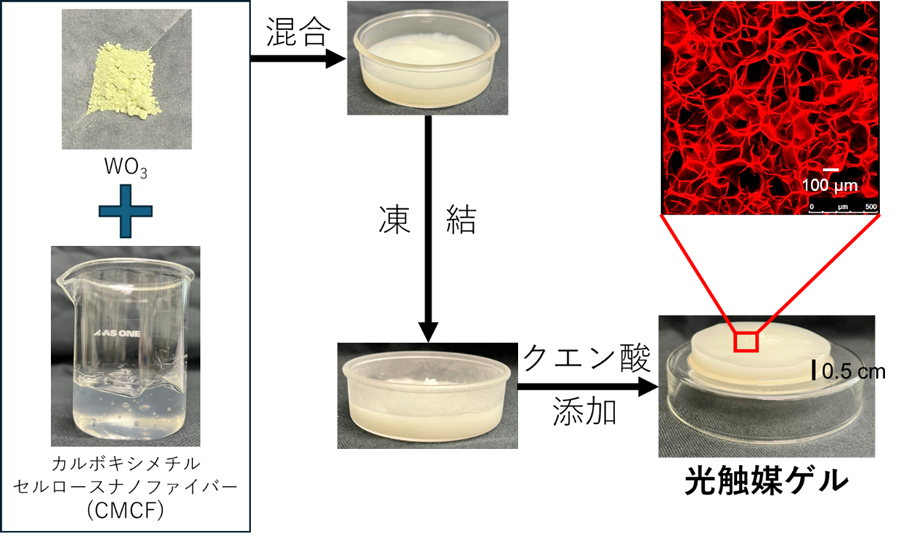
Developing photocatalytic materials with high efficiency and broad salt tolerance remains a major challenge for sustainable wastewater treatment. Here we developed a WO3-embedded hydrogel (WFG) by freeze–cross-linking that retained high activity even in the presence of coexisting salts. Confocal laser scanning microscope revealed interconnected channels <200 μm. ensuring good water permeability, and contrast-matching small-angle neutron scattering showed that the secondary particle size of embedded WO3 (∼300 nm) matched that in aqueous suspension. Under visible-light irradiation, WFG decolorized indigo carmine (INC) 1.5-fold increase in rate than suspended WO3 and 3.7-fold increase in rate than a WO3-coated glass plate. Coexisting salts (NaNO3, NaCl, Na2SO4, NaH2PO4) altered the decolorization efficiency; NaNO3 and Na2SO4 enhanced, whereas Cl− and H2PO4− suppressed the reaction, indicating that ionic strength and anion-species affect contact efficiency and charge transfer. WFG maintained >90 % of its initial IC-removal rate after five reuse cycles with minimal weight loss (< 3 %). These results clarify the structure–function relationship of gel-based photocatalysts and highlight their promise for practical visible-light water purification under variable ionic strengths.