2026-10-22 京都大学
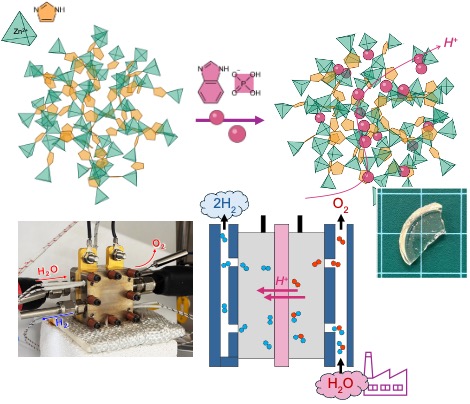
(上)今回用いたMOFガラスの模式図。この中にプロトンを通す修飾成分(赤で示す球)を入れることにより、水の電気分解に必要なプロトン伝導性膜を作ることができる。(下)水の電気分解の模式図および実際使用した電気分解セルの写真。
<関連情報>
- https://www.kyoto-u.ac.jp/ja/research-news/2026-10-22
- https://pubs.acs.org/jacsat/article-abstract/doi/10.1021/jacs.6c14370/5454885/Modifier-Driven-Proton-Conductivity-in-Hybrid?redirectedFrom=fulltext
ハイブリッドガラスにおける修飾成分がもたらす200℃超プロトン伝導 Modifier-Driven Proton Conductivity in Hybrid Glasses above 200 °C
Ellan K. Berdichevsky;Motoyasu Yamasaki;Takuya Kurihara;Taichi Nishiguchi;Siyuan Ye;Koki Ando;Yuta Hashiguchi;Hiromitsu Uehara;Carl K. Brozek;Satoshi Horike
Journal of the American Chemical Society Published:October 21, 2026
DOI:https://doi.org/10.1021/jacs.6c14370
Abstract
Compositional tuning is a cornerstone of inorganic glass science, yet analogous strategies remain underdeveloped for emerging metal–organic hybrid glasses. We introduce phosphate modification of zinc imidazolate glass as a route to hybrid glasses with tunable network connectivity and proton-conductive functionality. Melt-quenching of ZIF-zni with benzimidazolium dihydrogen phosphate (BP) affords a series of cm-scale, transparent bulk glasses across a wide compositional range. Systematic characterization reveals that modification proceeds through ligand exchange at zinc centers, increasing the average coordination number from 4 to above 5 and progressively depolymerizing the imidazolate network. Despite macroscopic homogeneity, X-ray total scattering identifies a quasi-periodic ordering at ∼11 Å, and 1H NMR spin relaxation establishes nanoscale phase segregation between ZIF-derived and BP-rich domains of 2–70 nm. This heterogeneity underpins proton transport under anhydrous conditions; conductivities of 10–5–10–3 S cm–1 at 240 °C follow Vogel–Tammann–Fulcher dynamics, confirming that segmental motion couples to ion mobility. Infiltrating the glass into a porous PTFE scaffold yields a composite membrane that achieves 8.4 × 10⁻⁵ S cm–1 at 170 °C under humidification and sustains steam electrolysis with near-unity Faradaic efficiency. These results establish network-modified hybrid glasses as a scalable and designable platform for intermediate-temperature solid electrolytes.