2026-10-10 合肥物質科学研究院(HFIPS)
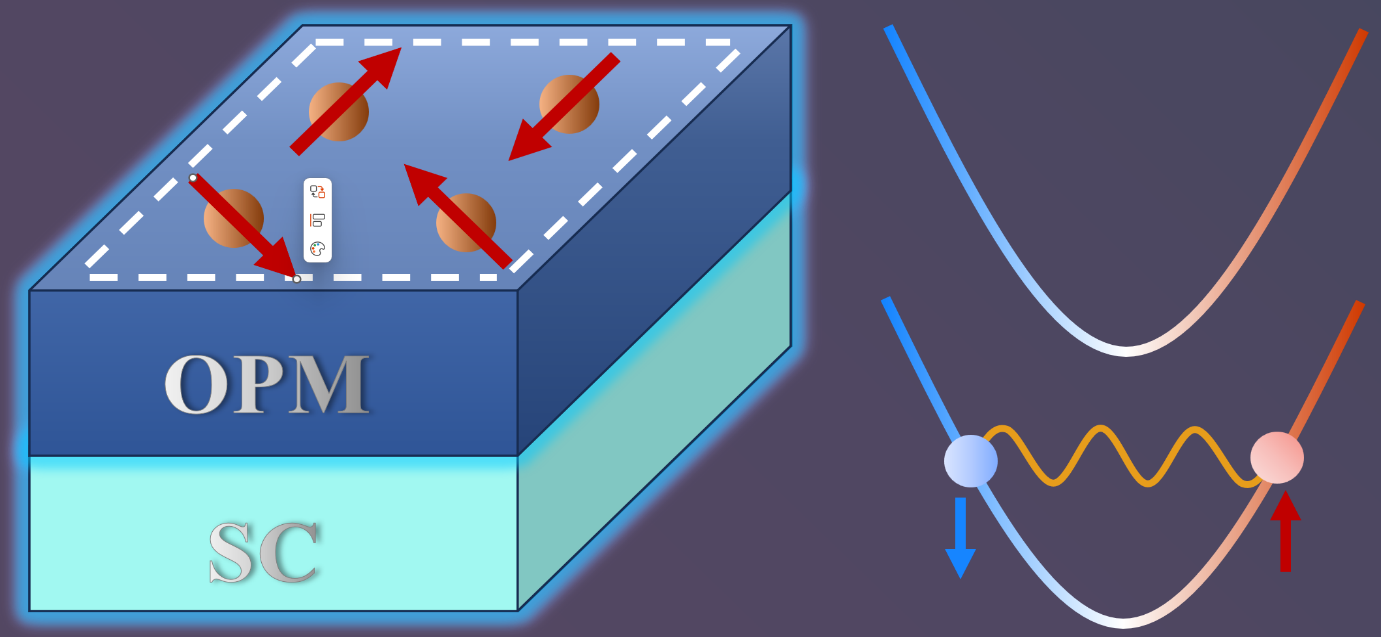
Schematic of the OPM/superconductor heterostructure and the mechanism of topological superconductivity: the unique band structure of odd-parity magnets, in which the NSS and the HZF coexist, makes them an ideal platform for realizing topological superconductors and Majorana boundary modes when coupled to a conventional superconductor. (Image by LUO Xunjiang)
<関連情報>
- https://english.hf.cas.cn/nr/bth/202610/t20261010_1202200.html
- https://journals.aps.org/prl/abstract/10.1103/j9m4-386b
奇パリティ磁石における隠れたゼーマン磁場:トポロジカル超伝導のための理想的なプラットフォーム Hidden Zeeman Field in Odd-Parity Magnets: An Ideal Platform for Topological Superconductivity
Xun-Jiang Luo, Zi-Ting Sun, Xilin Feng, Mingliang Tian, and K. T. Law
Physical Review Letters Published: 23 September, 2026
DOI: https://doi.org/10.1103/j9m4-386b
Abstract
Odd-parity magnets (OPMs) have emerged as a fundamental class of unconventional magnetism, characterized by time-reversal-preserving nonrelativistic spin splitting (NSS). Despite growing interest, the fundamental understanding of OPMs remains critically incomplete, as previous studies have focused exclusively on NSS while overlooking the intrinsically broken time-reversal symmetry () inherent to magnetic order. In this Letter, we demonstrate that OPMs universally host a hidden Zeeman field rooted in this breaking, which profoundly reshapes their band structure. Through an analytical study of an -wave magnet model, we reveal that the NSS microscopically originates from an emergent gauge field, manifesting as a real-space spin loop-current order in this model. Crucially, the large NSS (eV scale) enables conventional superconductivity to coexist robustly with the hidden Zeeman field, with the Zeeman splitting reaching hundreds of meV. This unique band structure establishes OPMs as an ideal platform for topological superconductors (TSCs), supporting large topological regions. Based on OPMs, we engineer a series of TSCs hosting distinct Majorana boundary modes, including unidirectional Majorana edge states. Our Letter corrects a fundamental misconception about OPMs and establishes them as a versatile platform for field-free and robust TSCs.