2026-10-10 中国科学院(CAS)
<関連情報>
- https://english.cas.cn/newsroom/research-news/202610/t20261010_1202173.shtml
- https://www.nature.com/articles/s41557-026-02275-7
高エネルギー密度フロー電池用可逆性Sn4 + /Sn0アノード Reversible Sn4+/Sn0 anode for high-energy-density flow batteries
Yue Ao, Xiaoxiao Wang, Chengji Zhao, Yanyan Zhang, Zhangquan Peng, Fuyi Wang, Shengli Chen, Congxin Xie & Xianfeng Li
Nature Chemistry Published:09 October 2026
DOI:https://doi.org/10.1038/s41557-026-02275-7
Abstract
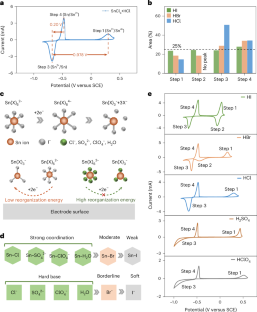
Aqueous batteries offer a relatively safe, energy-dense means to store electrochemical energy. Tin is a promising anode material, due to its potential four-electron redox-active states and lack of dendrite formation. However, the irreversible electrochemical behaviour of the Sn4+/Sn2+ couple have limited high-capacity anode development. Here we achieve the reversible Sn4+/Sn2+ conversion, enabling a Sn4+/Sn0 anode for high-energy-density flow batteries. We accomplish this by adding iodide to highly soluble SnCl4 solutions at ratios that form SnCl62− and SnI62− intermediate complexes. SnI62− reduces reorganization energy during the electrochemical reaction of Sn4+/Sn2+, ensuring reversibility. SnCl62− imparts anolyte solubility. The redox peak potential difference decreased from 978 mV (Cl−) to 97 mV (I−), with a substantial decrease to the electron transfer impedance decrease. Coupled with Br−/Br2, the assembled full battery showed 89% energy efficiency at 40 mA cm−2, 227 Ah l−1 anolyte capacity and 205 Wh l−1 anolyte energy density. Based on these studies, we developed a kilowatt-scale stack that can operate stably for over 1,000 h.