2026-07-09 大阪大学
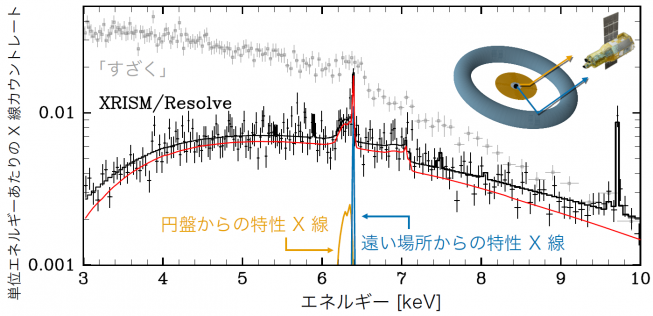
Resolve と過去の X 線天文衛星 「すざく」の X 線スペクトル (それぞれ、黒と灰色のクロスで表されている。)。
<関連情報>
- https://www.sci.osaka-u.ac.jp/ja/topics/16984/
- https://iopscience.iop.org/article/10.3847/2041-8213/ae796e
NGC 4395のXRISM時間分解Fe Kα分光観測:時間変動する内側円盤放射 XRISM Time-resolved Fe Kα Spectroscopy of NGC 4395: Time-variable Inner-disk Emission
Taiki Kawamuro, Satoshi Yamada, Hirofumi Noda, Yoshiyuki Inoue, Shoji Ogawa, and Misaki Mizumoto
The Astrophysical Letters Published: 2026 July 8
DOI:10.3847/2041-8213/ae796e
Abstract
We report the first XRISM observation of the low-mass AGN in the nearby dwarf galaxy NGC 4395 (MBH ∼ 104−5 M⊙), complemented by a simultaneous NuSTAR observation. We constrained the continuum by jointly fitting the XRISM/Resolve (2–12 keV) and NuSTAR (3–30 keV) spectra while excluding the Fe K band (5.5–7.5 keV). Relative to this baseline continuum, the time-averaged Resolve spectrum revealed an unresolved neutral Fe Kα core with a velocity width of ≲110 km s−1 and an adjacent redward wing. The red wing was well reproduced by an additional relativistically broadened Fe K component. Furthermore, time-resolved spectroscopy with ≈87 ks bins showed that the diskline profile varied significantly over the ∼400 ks observation. This evolution can be interpreted in terms of changes in the inner radius of the line-emitting region, together with a possible inclination modulation with a period of ≈210 ks. If interpreted as Lense–Thirring precession of a tilted inner flow, the observed period would favor the low end of the black hole mass estimates (MBH ≈ 9 × 10³ M⊙) and imply a moderate spin (a ≳ 0.6). These results highlight the capability of XRISM to track relativistic disk dynamics in AGNs.