2026-10-05 マサチューセッツ工科大学(MIT)
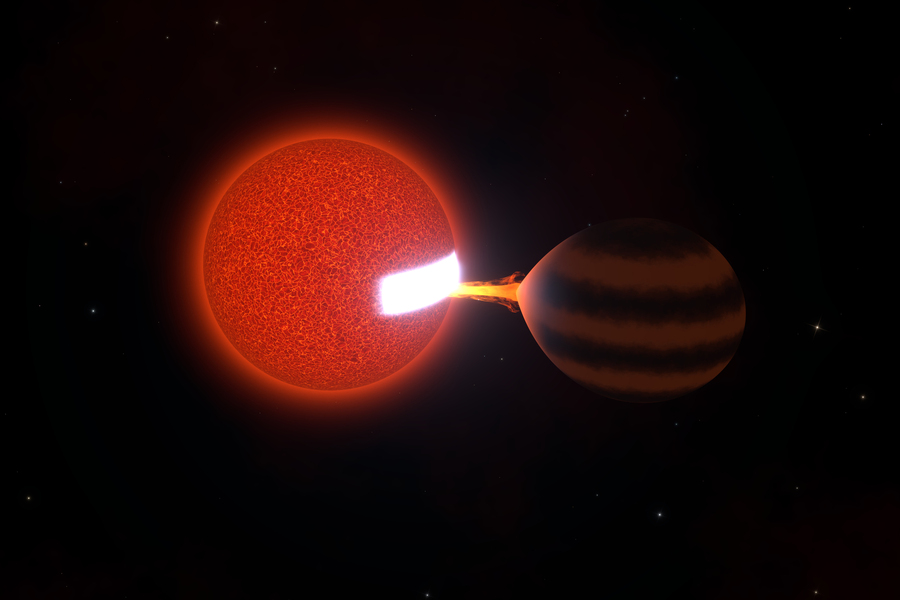
Artist’s impression of ZTF J0440+2325, a brown dwarf (right) and a red dwarf (left) that orbit each other every 86.65 minutes. The brown dwarf overflows onto its companion, and the stream of material strikes the surface of the red dwarf, heating a large hot spot at the point of impact. Credit: Aaron Householder (MIT)
<関連情報>
- https://news.mit.edu/2026/astronomers-catch-star-slowly-snacking-on-brown-dwarf-1005
- https://www.nature.com/articles/s41550-026-02992-6
準恒星天体からM型矮星への安定した質量移動 Stable mass transfer from a substellar object onto an M dwarf
Aaron Householder, Kaitlyn Shin, Kevin B. Burdge, Thomas R. Marsh, Saul A. Rappaport, Kareem El-Badry, Joheen Chakraborty, Emma Chickles, Fei Dai, Matthew J. Graham, S. R. Kulkarni, Pablo Rodríguez-Gil, Andrew Vanderburg & Samuel Whitebook
Nature Astronomy Published:05 October 2026
DOI:https://doi.org/10.1038/s41550-026-02992-6
Abstract
Substellar objects such as brown dwarfs and planets are generally expected to remain detached from their main-sequence host stars unless orbital decay or stellar expansion brings them into contact, leading to rapid engulfment and destruction. Such a fate is predicted for the Earth and other rocky planets in our Solar System. In certain cases, however, theory also allows for stable long-lived mass transfer from a substellar object onto its main-sequence host, although such accretion has not been observed. Here we report the direct observation of stable mass transfer from a substellar object onto a main-sequence star. In particular, we identify ZTF J0440+2325, an 87-min binary in which a brown dwarf stably transfers mass onto an M dwarf, and present ZTF J1444+4820 (P = 67 min) as a strong candidate low-mass mass-transferring system in a hierarchical triple. These systems demonstrate that the fate of some substellar objects is not rapid engulfment and destruction, but instead gradual consumption for potentially billions of years.