2026-06-16 早稲田大学
<関連情報>
- https://www.waseda.jp/inst/research/news/84715
- https://journals.aps.org/prresearch/abstract/10.1103/zgvb-cfpg
アメーバに着想を得た組み合わせ最適化マシンの物理的実装のための数理モデルと、そのリカレントニューラルネットワークとの等価性 Mathematical model of the amoeba-inspired combinatorial optimization machine for physical implementation and its equivalence to recurrent neural networks
Yusuke Miyajima and Masahito Mochizuki
Physical Review Research Published: 9 June, 2026
DOI: https://doi.org/10.1103/zgvb-cfpg
Abstract
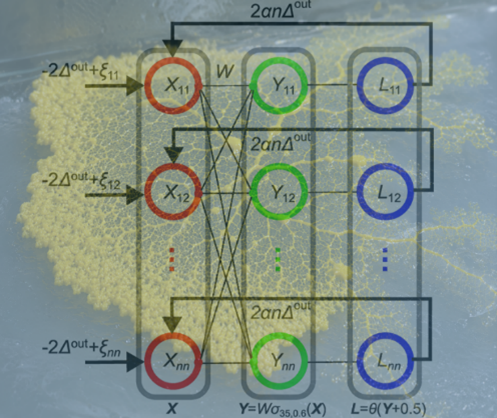
Information-processing algorithms inspired by survival strategies of slime molds have been intensively studied to realize combinatorial optimization machines with high computational efficiency and low power consumption. However, previously proposed mathematical models are not suitable for physical implementation as they involved constraints due to the volume-conservation law of slime molds, multiple conditional branches, and numerous complex functions such as sigmoid functions. Here, we propose a mathematical model, the Amoeba TSP (traveling salesman problem) recurrence formula model, which simplifies the information-processing procedure and enables physical implementation without sacrificing optimization performance. Specifically, we demonstrate using numerical simulations that (1) the conservation-law constraints assumed in previous models can be removed, (2) several sigmoid functions can be eliminated, and (3) Gaussian-distribution random numbers that can be generated from thermal fluctuations can be employed as random fluctuations. These improvements broaden the range of candidate materials and phenomena for physical implementation and reduce the number of device components required. Furthermore, we discover that our mathematical model integrating these modifications is mathematically equivalent to a recurrent neural network with fixed weights that exploits nonlinear dynamics. Remarkably, despite its significant simplification, the proposed model exhibits superior solution-search performance compared with the previous models in terms of solution quality, convergence speed, and scalability. Our results open a practical pathway toward realization of highly efficient and high-performance combinatorial optimization machines based on non-von Neumann-type architectures and provide insights into bioinspired information processing by uncovering a connection between the computational principles of slime molds and recurrent neural networks.