2026-06-16 沖縄科学技術大学院大学
 学
学
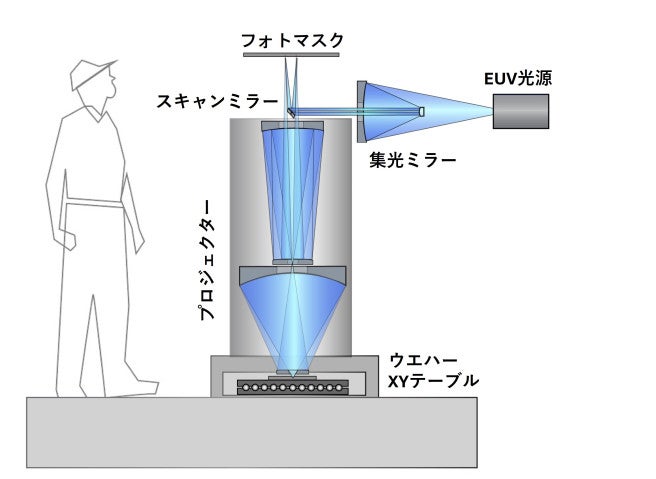
図は、新竹教授が提案する高開口数(NA) EUVリソグラフィーを示している。照明システム内の集光ミラーは、EUV光源からの短波長光をフォトマスクに導くために、よりシンプルな設計となっている。プロジェクター内の2組のミラーにより、開口数が向上している。フォトマスク上の回路パターンがウェハーに投影され、その後、化学エッチングが行われることで、シリコン表面に高密度なナノメートル級の線状パターンが形成される。このプロセスを20回以上繰り返して、最終的に20層以上パターンが積層され、回路として機能するチップが製造される。© 新竹積(OIST)
<関連情報>
- https://www.oist.jp/ja/news-center/news/2026/6/16/redesigned-high-na-lithography-optical-system-aims-revolutionize-semiconductor-chipmaking
- https://www.spiedigitallibrary.org/journals/journal-of-micro-nanopatterning-materials-and-metrology/volume-25/issue-02/023801/High-NA-in-line-projector-for-EUV-lithography/10.1117/1.JMM.25.2.023801.full
EUVリソグラフィ用高NAインラインプロジェクター High-NA in-line projector for EUV lithography
Tsumoru Shintake
Journal of Micro/Nanopatterning, Materials, and Metrology Published:12 Jun 2026
DOI:https://doi.org/10.1117/1.JMM.25.2.023801
Abstract
We propose a simple, four-mirror, in-line projector for high-NA EUV lithography that eliminates the most troublesome mask 3D effect. The design consists of a two-stage concave-convex pair, where optical aberrations are canceled within each stage and between them, in a manner similar to that of the double-Gauss lens. The light rays pass through the central aperture in each mirror with acceptable obscuration. The numerical aperture is 0.5 and 0.55. It has a circular exposure field with a diameter of 20 and 30 mm, respectively. The residual radial distortion is rather high at a few microns at the field rim, and the scan motion causes image blurring in the scanner. Thus, we need to revert to the stepper design, and the field becomes smaller, i.e., 14 mm×14 mm square and 21×21 mm. However, we can remove the scanning mechanism from the photomask side; thus, it makes the system simple. It is important to note that both the wafer and the photomask remain stationary during the EUV exposure. Illumination will be provided through two rectangular scan-mirrors located in front of the mask, providing dual line scan field, which matches with off-axis illumination enhancing the resolution and bypassing the central obscurations.