2026-08-17 スイス連邦工科大学ローザンヌ校(EPFL)
<関連情報>
- https://actu.epfl.ch/news/how-do-you-measure-one-third-of-an-electron/
- https://www.nature.com/articles/s41567-026-03412-2
量子ホール効果を利用した分数クーロンメーター Quantum Hall antidot as a fractional coulombmeter
Mario Di Luca,Emily Hajigeorgiou,Zekang Zhou,Tevž Lotrič,Tengyan Feng,Kenji Watanabe,Takashi Taniguchi,Steven H. Simon & Mitali Banerjee
Nature Physics Published:14 August 2026
DOI:https://doi.org/10.1038/s41567-026-03412-2
Abstract
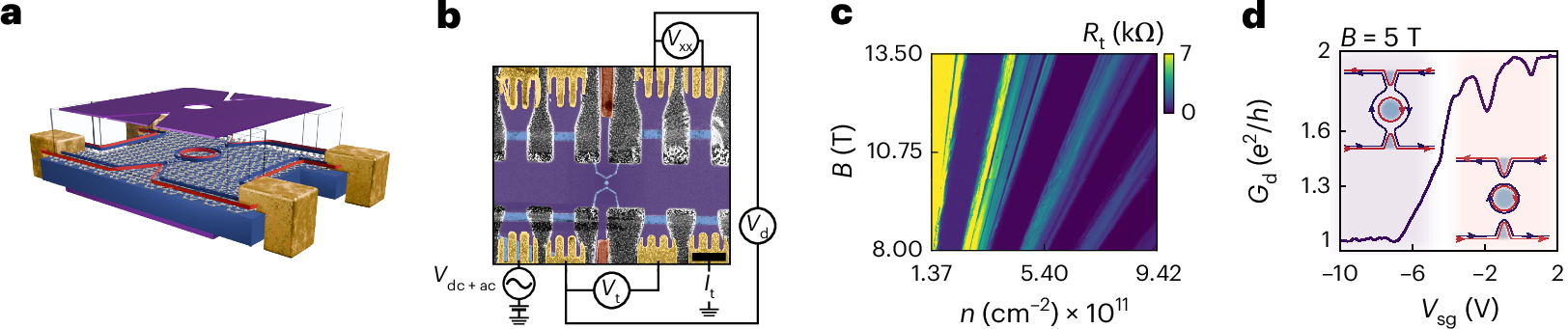
The ability to detect the fractionally charged quasiparticles that arise in the fractional quantum Hall regime is of fundamental importance for probing their quantum properties. Although electronic interferometers have successfully probed their statistical properties, interpreting the results is often complicated by bulk–edge interactions. Antidots—tunable hills in the potential landscape in the device—are particularly valuable in this context, as they overcome the geometric limitations of conventional interferometer designs and act as controlled impurities. Here we demonstrate a method for extracting the charge of quasiparticles as they tunnel through an antidot. To accomplish this, we employ a gate-defined bilayer-graphene antidot operating in the Coulomb-dominated regime to study quasiparticle tunnelling in both integer and fractional quantum Hall states and we report direct measurements of fractional charge. Our derived theoretical model indicates that the differences in the measured charges may be attributed to variations in edge re-equilibration arising from a different parity of downstream integer edge modes. The simplicity and tunability of this design open a pathway to extending antidot-based charge measurements to other van der Waals materials and establishing antidots as a broadly applicable platform for studying topological materials.