2026-08-17 中国科学院(CAS)
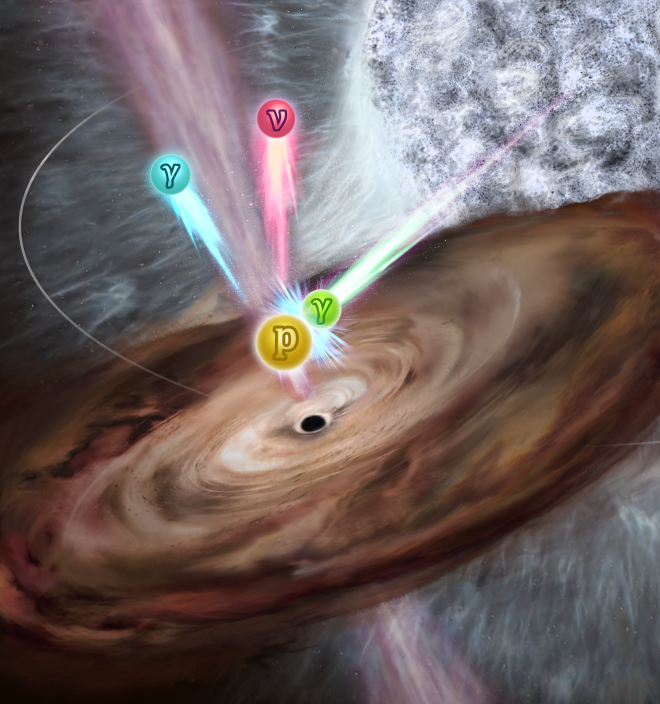
Schematic diagram of high-energy photons and neutrinos produced by interactions between protons from the base of the Cygnus X-3 jet and ultraviolet photons from the companion star. (Credit: LHAASO Collaboration)
<関連情報>
- https://english.cas.cn/newsroom/research-news/202608/t20260817_1187949.shtml
- https://academic.oup.com/nsr/advance-article/doi/10.1093/nsr/nwag435/8740106
はくちょう座X-3:可変ペタ電子ボルトγ線源 Cygnus X-3: A variable petaelectronvolt γ-ray source
Zhen Cao,Felix Aharonian,Yun-Xiang Bai,Yi-Wei Bao,Denis Bastieri,Xiao-Jun Bi,Yu-Jiang Bi,Wen-Yi Bian,Jeffrey Blunier,Anatoly V Bukevich,…
National Science Review Published:22 July 2026
DOI:https://doi.org/10.1093/nsr/nwag435
Abstract
We report the discovery of variable γ-rays up to petaelectronvolt (PeV; 1PeV=1015eV) from Cygnus X-3, an iconic X-ray binary. The γ-ray signal was detected with a statistical significance of approximately 10σ by the Large High Altitude Air Shower Observatory (LHAASO). Its intrinsic spectral energy distribution, extending from 0.06 PeV to 3.7 PeV, shows a pronounced rise toward 1 PeV after accounting for γ-γ absorption by the cosmic microwave background radiation. We find variability on month-long timescales at a significance of 8.6σ, coinciding with a high state of the GeV γ-ray flux detected by the Fermi-LAT. This, together with a 3.2σ evidence for orbital modulation, suggests that the PeV γ-rays originate within, or in close proximity to, the binary system itself. The observed energy spectrum and temporal modulation can be naturally explained by γ-ray production through hadronic processes in the innermost region of the relativistic jet, where protons are accelerated to tens of PeV energies.