2026-06-09 中国科学院(CAS)
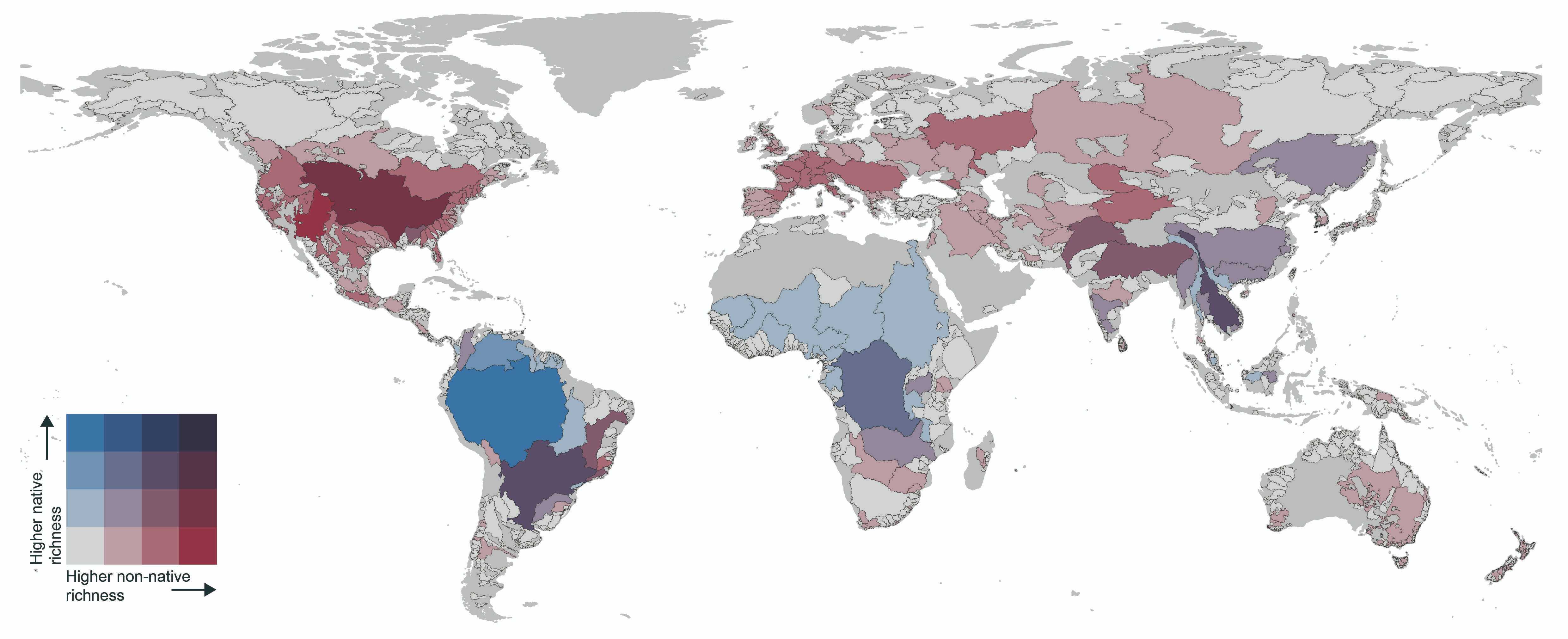
Native niche differentiation promotes biotic resistance to freshwater fish invasions worldwide. (Image by IHB)
<関連情報>
- https://english.cas.cn/newsroom/research-news/202606/t20260609_1161419.shtml
- https://onlinelibrary.wiley.com/doi/10.1111/gcb.70905
在来種のニッチ分化は、世界中の淡水魚における外来種侵入に対する生物的抵抗力を促進する Niche Differentiation of Native Species Promotes Biotic Resistance to Invasion in Freshwater Fishes Worldwide
Chengzong Tian, Bo Yang, Jorge García-Girón, Zhongyang Li, Zi Xun Kua, Xiaopei Du, Wei Xin, Xiongdong Zhou, Ming Duan, Yushun Chen
Global Change Biology Published: 14 May 2026
DOI:https://doi.org/10.1111/gcb.70905
ABSTRACT
Understanding the resistance of native fauna to biological invasions is essential for predicting and managing freshwater fish diversity under accelerating global change. Using fish and environmental data from 2622 river basins worldwide, we quantified how niche differentiation, phylogenetic and functional diversity, and richness of native species, as well as environmental factors contribute to non-native fish richness and occurrence. Our results show that niche differentiation of native fishes is the key determinant of biotic resistance: when native species occupy broader and more heterogeneous niche spaces, both the richness and occurrence probability of non-native fishes decline significantly, a pattern that holds consistently across global and biogeographic scales. Functional and phylogenetic diversity exert partially constraining effects, yet their influence varies across invasion metrics and spatial scales, thereby limiting their predictive power. Native richness promotes the naturalization of non-native species but does not significantly influence invasion richness. Notably, non-native fish invasions follow a nonlinear latitudinal gradient, intensify with increasing human pressure, and are positively associated with basin area. These findings demonstrate that freshwater fish invasions are jointly shaped by biotic interactions, environmental filtering, and human activities, with native niche differentiation emerging as the primary driver of biotic resistance. By incorporating niche-based mechanisms, this study provides a unifying perspective for reconciling the invasion paradox and offers a process-based foundation for developing integrated invasion management strategies under global change.