2026-06-09 カリフォルニア大学サンタバーバラ校(UCSB)
<関連情報>
- https://news.ucsb.edu/2026/022614/new-rainfall-dataset-enhances-global-monitoring-extreme-weather
- https://www.nature.com/articles/s41597-026-07096-4
気候災害センター赤外線降水観測データ(観測地点付き)、バージョン3 The Climate Hazards Center Infrared Precipitation with Stations, Version 3
Chris Funk,Pete Peterson,Laura Harrison,Robert Saldivar,Martin Landsfeld,Diego Pedreros,Shraddhanand Shukla,Andreas H. Fink,Frank Davenport,Seth Peterson,William Turner,Austin Sonnier,Michael Budde,Karyn Tabor,James Verdin,Disha Hauzaree,Mohamed Naim,Daniella Alaso & Gregory Husak
Scientific Data Published:11 April 2026
DOI:https://doi.org/10.1038/s41597-026-07096-4
Abstract
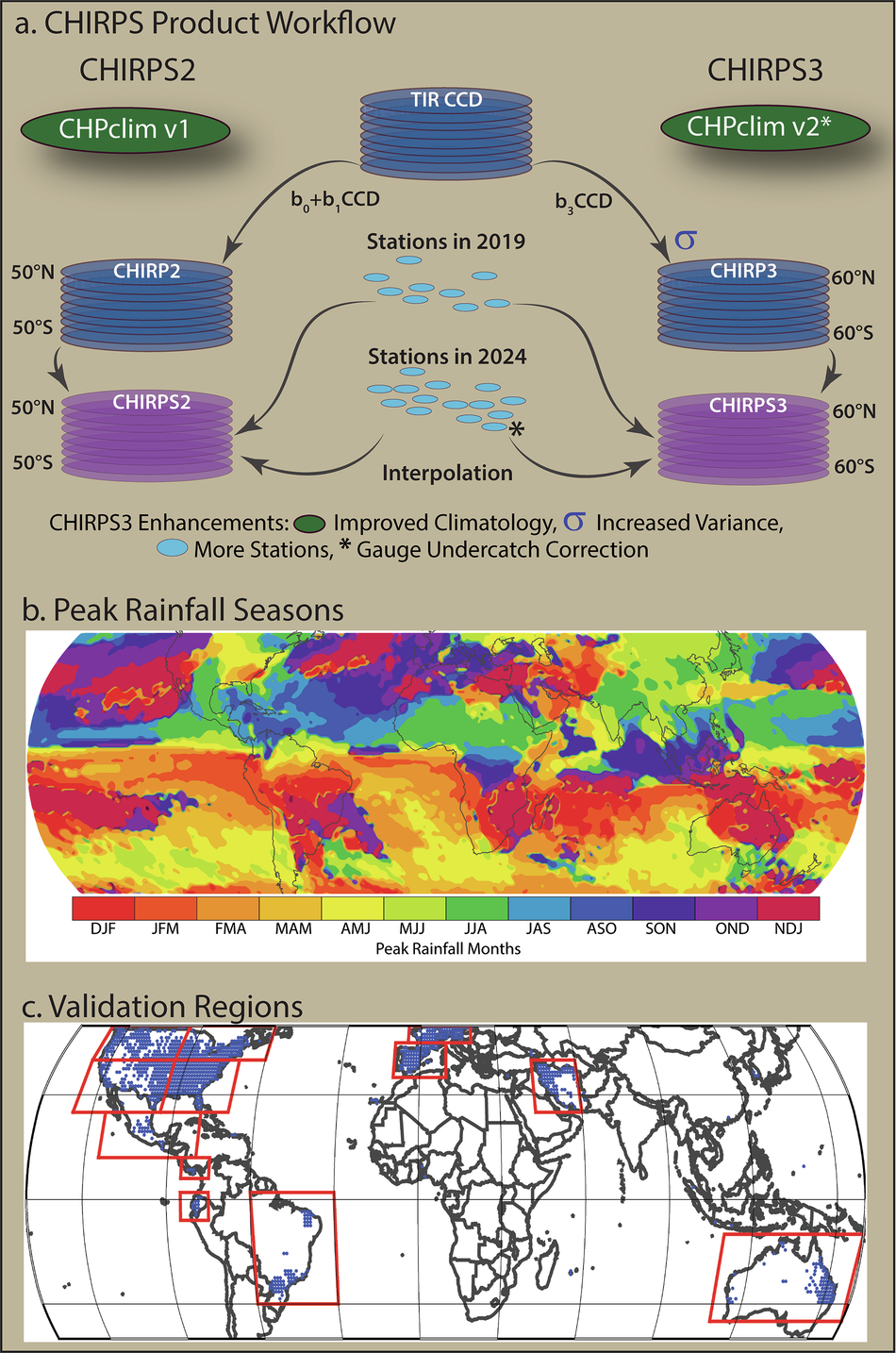
The Climate Hazards Center Infrared Precipitation with Stations (CHIRPS) data stream combines: (1) a high-resolution climatology, (2) thermal infrared (TIR) geostationary satellite observations, and (3) station observations. In the past, CHIRPS version 2 (CHIRPS2) has proven to be valuable for drought monitoring, hydrologic modeling, scientific studies and agricultural decision making. Version 3 (CHIRPS3) improves each of these components. The new version, CHIRPS3 extends to 60°S/N, adopts an improved variance-preserving TIR-to-precipitation estimation method, uses many more stations and station sources than the original CHIRPS2 product, and implements gauge-undercatch correction. In this paper, we evaluate the performance of satellite-only CHIRP3, CHIRP2, IMERG, PERSIANN- CCS, and GPI using high quality interpolated data in twelve regions with dense station coverage. CHIRP3 represents both the observed mean and variance more accurately than CHIRP2. A usage section in Morocco shows that CHIRPS3 better captures the observed rainfall variability when compared to CHIRPS2. This section also demonstrates how station data should be gauge-undercatch-corrected when validating CHIRPS3.